Showing posts with label ecology. Show all posts

Monday, May 2, 2011

A Short Mid-Season Post

In my last post, I was patiently waiting for field season to start. And then, all of a sudden, it did -- a few warm days and blueberry bloom was off and running.

Today was an easier day -- it would have been our seventh day of data collection (we need fourteen this year), but the morning was too cool and overcast to be a "good bee day", so the crew and I came back to the lab for a much-needed day of bee pinning and downtime.

I've also had a chance to go through some of my photos, and I even took a few more today of the various critters that visit the honeysuckle bush at the field station. One of the nicest things about staying here is looking out the window while I'm cooking or washing dishes and watching bumblebees visiting flowers. They get absolutely covered in pollen. It's fantastic.

I'm not going to write a whole lot tonight (more data collection tomorrow, so I need to get to sleep soon!) but here are a few photos of what I've been seeing out in the field. The white bell-shaped flowers are blueberry (Vaccinium corymbosum, highbush blueberry). Enjoy!

Bumblebee (Bombus) species mid-flight.


This is my best Habropoda laboriosa photo to date, you can actually see her face in this one, yay! Also take a look at all the pollen on her legs! I wish her hundreds of fat children.

Fun fact: "Habs" are actually as soft as they look!


One of the best parts of my field work (and also one of the most frustrating) is feeding bees by hand. Here you can see my triumphant feeding of a Colletes spp. female, who has just visited one of the open flowers near the top of the cluster. At the bottom you can just see my hand holding the water tube; this flower was eventually taken back to the lab and is now a data point in training!

Tuesday, April 12, 2011

Where I've Been

Before I start writing up what I'm doing right now, here's a little recap of the last 18 months or so, to put my absence in perspective. Not the most exciting post, but it will put my forthcoming field season posts in perspective!

From October 2009 through March 2010, I wrote my preliminary proposal for my thesis project. Most people take their qualifying exam (aka "Quals") first, but I did things backwards. I'm wacky like that.

As part of my preliminary proposal, I spend a lot of time using GIS to select sites for my study. Since I'm comparing effects of landscape at different scales, site selection is a huge aspect of my project. In the end, I came up with 16 sites and two control sites, all blueberry fields in southern New Jersey. This took most of March.

On April 1st, I started training a field crew of five people, including myself. It was a good thing we started early, because last year was one of the earliest blooms on record for blueberry in this region. Our first day of data collection was April 15, which was already a few days into bloom; we were done with data collection on May 5. Short field season!

From May 6 or so right up to last month, I have been analyzing my data. Really. It's still ongoing, but I had to take a break from analyzing the data to collect more data, starting... probably next week. More on that to follow.

But, data analysis isn't all I do! (Although, it's most of what I do.) I also spent a few months studying for my quals (and passed, thank Darwin that's over!), gave a 10-minute talk at the Entomological Society of America meeting in San Diego last December, started writing a paper with my advisor, and have learned a bit of programming in R. I also got a great teaching gig that lets me teach only in the Fall semester, so I can focus on my field season in the spring. I've also learned to bake foccacia. Overall, it's been a busy 18 months!

I'll write more about the current field season soon, but in the meantime, here are some early-season critter photos. Enjoy!


Gorgeous green beetle.


Habropoda laboriosa male feeding on leatherleaf (Chamaedaphne calyculata) flowers. Leatherleaf is one of the earliest blooms in this area, and hungry early-emerging spring bees were all over it!

Wednesday, June 10, 2009

Once Upon a Field Season

HELLO WORLD!

I'm BACK.

This is a blueberry field on April 22. Notice that it is 1) not in bloom and 2) raining.


A different field, on May 4. You may notice that it is still quite grey and, in fact, the day this picture was taken it was also raining. (This will be the ongoing theme of field season.)


The ongoing dismal weather grounded the local turkey vulture population. They liked to hang out in one particular dead tree near this field. You can see them in the above photo, but here is a close-up.


The next day was another rainy one. Since bees don't like the rain very much, I didn't see very many. I did see some other beautiful little things:

A green spider amid the pink blooms, how very Lily Pulitzer.

I think this tiny arachnids is some sort of crab spider. That flower is about 8 mm long.

Back at the field station, I saw this little guy puffing himself up against the cold weather. A few buzzed me at my field sites as well, but I didn't get any photos. Too bad the light was so dull, you can't really see the ruby-red.

Eventually the weather dried out a bit and we had clear skies for a few days. Of course, the Pinelands are a fire-happy ecosystem, so when I looked up and saw this:

I placed a call to the police to find out whether I needed to evacuate my field site. Fortunately it was a controlled burn and was put out quickly. It smelled very nice, actually, since they were burning a patch of pine forest.

Oh! Right! I also saw some bees!

Since it was a very early season, most of the Bombus I saw were queens. You can tell Bombus queens from workers by the fact that the queens are as big as your thumb and sound like helicopters, while the workers are relatively quite small (especially early in the season). This is probably Bombus impatiens. Fun fact: bumblebees are actually as soft as they look.

A number of other native bees appeared at my field sites, although generally not in any great numbers. This is one of my favorite native bees. It's in the genus Colletes and the orange hairs make them look like they're wearing tiny fox-fur jackets. Eventually they get around to sticking their heads into a few flowers, but they don't work constantly like the bumblebees do.

I'll post again soon, but it's been so long that I have to split things up over several entries. In the meantime, click on the photos to see them larger -- they look really good full-screen, thank goodness I learned how to use the macro on the camera before the season started. Enjoy!

Wednesday, November 26, 2008

Better Know an Insect: Fungus Farmers

Happy Thanksgiving!

A few weeks ago, I read some interesting papers about mutualisms in ecological networks.

Here is a thought-provoking opening sentence from one of them:
About 40 – 60 million years before the advent of human agriculture, three insect lineages, termites, ants, and beetles, independently evolved the ability to grow fungi for food (Mueller & Gerardo, 2002).

As you digest your delicious Thanksgiving meal, think of all the things we farm, and the complex relationship we have with agriculture, with farmers, and with the organisms we farm. Then contemplate that insects did it all way before us with their tiny little nervous systems.

Leafcutter ants are one of the lineages that have developed the ability to farm. You might have seen leafcutters in a museum -- they're popular exhibits because they will build their entire colonies readily inside an enclosure and only require a steady supply of leaves. They are the champion farmers of the insects; in some areas, they are considered major agricultural pests because they will strip all vegetation near their colonies to feed their fungus colonies.

The life cycle of leafcutter ants is something like this: when a new queen hatches, she takes a small amount of her home colony fungus along with her on a specialized structure on her thorax when she makes her nuptial flight. After mating, she founds a new colony with the fungus she carried with her. The fungus grows on decomposing vegetation -- leaves -- which the queen initially supplies. After her first offspring have developed, they take over the role of leaf-gathering so that the queen can focus entirely on laying eggs.

Humans go to great lengths to maintain their crops. We spray insecticides, fungicides, and other chemicals to keep our crops disease-free. Ants have developed a system to do this as well -- on each worker is a small patch containing beneficial bacterial colonies. These bacteria secrete antibiotics that help protect the fungal crop from disease. The ants can also adjust the kind of vegetation brought into the colony, and will not bring leaves that have previously been rejected by or toxic to the fungal crop.

Two amazing, related facts about leafcutter ants: 1) they are native to the Americas (especially Central and South America) and are not found on other continents; therefore, when you see a line of leafcutter ants in The Lion King (sorry, I'm having a hard time finding a screenshot) that is an error.

2) While most leafcutters make their homes in the tropics, one species actually lives as far north as southern New Jersey.

There's loads more to say about leafcutter ants, but I mainly wanted to talk about farming in this post, since it sort of relates to Thanksgiving. Perhaps I'll write about them again soon. Eusocial insects are my favorite insects to talk about since they do so many amazing things. Look for more on ants in the future!

Sources:
Mueller, Ulrich G. and Nicole Gerardo. Proc Natl Acad Sci U S A. 2002 November 26; 99(24): 15247–15249.

Thursday, October 2, 2008

Corny Ads

Lately there have been some very interesting ads on television and in newspapers. Perhaps you have seen them. In the TV ads, the script is something like this:
Person A: Ew, you're eating that? It contains corn syrup!

Person B: So? It's made from corn. Corn is a plant! What's wrong with it?

Person A: Uhm... I... uhm... can I have some?
You can check them out on YouTube: Ad 1 and Ad 2.

Naturally, these ads have been lighting up the food blogosphere. The Jew and the Carrot (hereafter known as JCarrot and now part of my blog biscuit) had a good, long post about them a few days ago, and I don't want to just repeat everything that they said, so check out their post. I just wanted to bring this to your attention, in case you're like me and don't actually watch enough TV to see these things for yourself.

Don't be like the folks in the commercial, clueless when it comes to actual reasons to avoid corn syrup. There are plenty of good reasons, having nothing to do with its nutritive value. Notice that in the commercials, the products are "fruit drink" and a popsicle, things we expect to be sweet... had they shown breadcrumbs, canned soup, tomato sauce, or any of the myriad products that really *don't* need to be additionally sweetened, I would hope that Person A would reply, "But why do you need to have corn syrup in your breadcrumbs/tomato sauce/chicken soup/whole wheat bread in the first place?" and it would be Person B's turn to be at a loss for an answer.

Actually, that's not a bad idea... maybe we should get some talented filmmakers to make alternative versions of these ads and post them as responses on YouTube to the corn syrup ads. Any volunteers?

In the meantime, though, read the JCarrot article for some suggestions about why corn syrup is, in fact, not all that great. (Although in my conversations with Aliza, I have learned that nothing is nearly as simple as we'd like it to be.) And, you know, while you're at it... keep reading JCarrot, it's a great blog!

PS: I have no idea why I didn't post this when I wrote it. So I'm posting it now, a little late but better than never, right?

Tuesday, August 12, 2008

Better Know an Insect: Anax junius, part I

I post a lot about what's going on in the world of science, but I haven't posted much about what I'm doing.

Today, that changes.

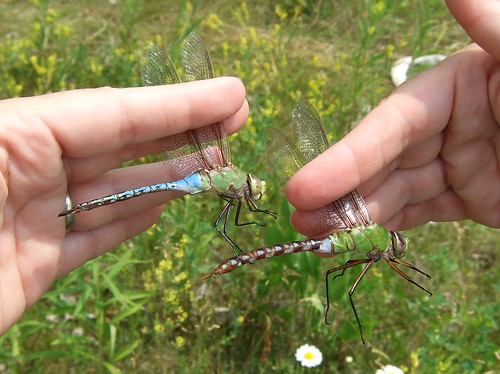
Ladies and gents, this is Anax junius, the green darner dragonfly:

Male green darner.

Female green darner.

Take a good look, because you'll be hearing a lot about these guys in the future.

Today was a testing day for Mike and myself. (Mike is my advisor.) We received some very small transmitters a few weeks ago, but because of various things (his trip to South Africa, my shuffling between NJ and LI, logistics, etc.) the plan finally came together only this week.

(Please bear with me. I forgot my camera, I will try to describe things as well as I can, and I will hopefully have some more pictures tomorrow.)

After borrowing a van from Princeton, which may or may not prove handy depending on how well we can use our radio antenna, we headed to a pond and spotted a few Anax. Mike being in possession of the one pair of waders, he went on in while I stayed on shore in case any made an escape attempt in my direction. We were very lucky, and Mike bagged a male (like the picture above) within a few minutes. Back on shore, we sat down in the shade (don't want the little guy to overheat) and proceeded to apply a radio transmitter with a combination of eyelash adhesive and crazy glue. Once it was on, he sat on Mike's finger, shivered his flight muscles for a few minutes to warm back up, and took off.

We were able to follow him for a bit into some trees (apparently, green darners that have been man-handled will retreat to trees away from the pond) and then lost the signal. Driving around, we were able to find his blip again, only to lose it a few minutes later. We are concerned that the soldering was not as firm as we'd like and the transmitter may only be transmitting intermittently (that's a mouthful!).

Our plan for tomorrow is to 1) try to find our guy again in the same area. If we are successful... well, actually I don't know. I think we'll just try to keep an eye on him as long as we can. 2) If we can't find him, we'll first do a practice run with just a transmitter to test the range of a properly-functioning beacon. After that... probably try to bag another one and follow it around for a while.

What's the point of all this? Well, our project is on migration in Anax. So, we're trying to figure out whether it's even feasible to tag one, relocate it, and follow it for several days over land. It has been done before, but we're both new-ish to the technique. And it's not easy.

I'll post more in the next few days about the exciting world of insect endocrinology and how hormones may influence migratory behavior -- an under-explored area which might become part or all of my project if it proves too difficult to consistently follow tagged individuals. Also, pictures next time.

PS: In case you were thinking that we were attaching big, heavy transmitters to dainty damselflies, rest assured, we are not. Green darners are anything but dainty. Go out to a pond, take a look at all the dragonflies you see, and look for the biggest thing flying around. That's probably an Anax species. A picture for size comparison:

Male A. junius and female A. longipes.

I didn't take this picture and those aren't my hands, but this will give you some idea of just how big these guys are. Totally harmless, of course, but definitely massive!

Saturday, July 5, 2008

DIY Dairy

In the spirit of reducing packaging from foods (is seltzer a food? maybe in Hollywood?) that I love, consider the yogurt maker.

"But dairy products were not meant to be made at home!" you might think. "They are frequently complicated, sometimes involve caves, and are generally not DIY projects!" Ah, but that is not always true. Yogurt is actually incredibly easy to make at home; technically, you don't even need a yogurt maker, but having one can greatly improve the reliability of your results. (And as a scientist, I am always in favor of reproducible results.)

Yogurt is delicious but also tends to arrive in non-recyclable plastic containers, creating even more guilt than recyclable seltzer bottles. (Yes, in some places you can recycle plastic #5, but for whatever reason, those places don't include New Jersey.) It also tends to come in fairly standard flavors, like peach and blueberry. Making yogurt at home allows you to create your own flavors. If I get a yogurt maker at some point in my life, I might start with herbal or spiced yogurts (lavender? thyme? cumin?), maybe play with extracts... cherry-almond is one of my favorite combinations, so a little almond extract (or even almond milk?) might be a tasty addition. We'll see how it goes.

Monday, June 9, 2008

Bagels and... what?

Hmm. Zabar's will have their hands full trying to make sardines the new lox. Good luck with that.

Sardines with your bagel?

Despite what seafoodwatch.org might say, salmon is probably best to just keep on your Avoid list. I'm not sure how recently they updated the list, but it probably hasn't been updated since the Pacific fisheries south of Alaska were closed. With prices on Alaskan salmon poised to go through the roof, you might want to find something new to put on your bagel.

Unfortunately, the other classic bagel topper, whitefish, is also a no-go. Atlantic cod, aka whitefish, is a big red Avoid on that list. But if you're a fan of herring in cream sauce, you're doing A-OK, since herring (aka sardines or kippers) are considered a Best Choice.

Of course, the other option is to not put any fish on your bagel at all. I like mine toasted with a little butter, tomatoes, and a slice or two of manchego. Simple, delicious, and definitely dolphin-safe!

Saturday, May 31, 2008

You say CAFO, I say IFAP...

The Pew Charitable Trusts and the Union of Concerned Scientists have published reports that say that our current animal husbandry system is inhumane, inefficient, and disgusting.

Yeah. We already knew that, but it's nice to have confirmation from people with recognizable names!

Yesterday I went to the Rutgers Farmers' Market (I'm not really sure what to do with that apostrophe, by the way; anyone have a suggestion? If multiple farmers are selling things, it goes at the end like that, right?) for the first time. The produce selection was limited, but one item was in abundance: meat. There were bison steaks and burgers, chickens -- whole, deboned, sausaged -- quail, maybe even lamb, I don't remember exactly. Locally and humanely raised, the whole lot of it. I wish it were as simple as "stop eating meat" but if that's not really the way you want to go, check out your local farmers' markets; you might be surprised at the variety of non-vegetable foods available to you. (I'll get some links to the NJ ones up soon.)

Friday, May 30, 2008

Guano

There was about a week there with no posts; sorry about that. I was busy, and there was Memorial Day weekend, and it took a few days to get myself back together.

This article, in two short pages, manage to cram in a lot of interesting information about colonialism, the pre-petroleum world, sustainable fishing, sea bird conservation, organic farming, and other topics.

Peru Guards its Guano as Demand Soars Again.

Guano is bird droppings; colonial birds such as the cormorants and boobies mentioned in this article produce a lot of it every year. Before humans figured out a way to make synthetic fertilizer (leading to corn that is grown with petroleum, which doesn't really help us when you make it into ethanol), guano was the richest soil amendment you could buy.

What I'm not too clear on is why seabird guano is so particularly sought after. We have millions of captive chickens, turkeys and ducks; can't we use some of their droppings in a similar way? If anyone has a good explanation about this (is it something about the level of fish in the diet?) I would love to hear it.

Anyway, it's an interesting article. It gives a little more insight into just how this massive food chain we've created works. Fish that would go to seabirds are instead going to chickens (which don't normally eat fish); declining seabird numbers means less guano for organic farmers to use on vegetables. The price of petroleum goes up to the point that "conventional" petroleum-based farming is too expensive, so farmers of all stripes are looking for alternative fertilizers.

Thursday, May 22, 2008

Better Know an Insect: Plant-Ants and Ant-Plants

"In the present paper, plants with ants living in them will be called 'ant-plants'; the ants will be called 'plant-ants.' "

~Dan Janzen (1966)

Whatever you decide to call them, myrmecophytes (ant-plants) are an interesting area of research. I recently wrote a term paper on the subject because they came up in the chapter on mutualisms and I couldn't stop thinking about them.

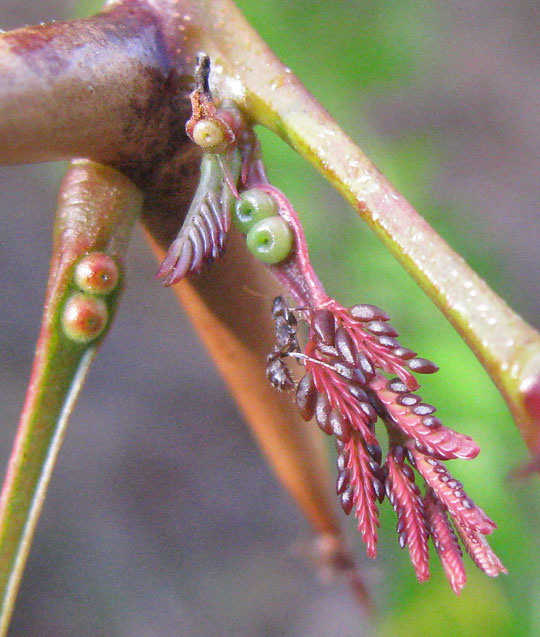
This is a bullhorn acacia tree; similar trees live in the tropics around the world:


This is a South American acacia-ant, Pseudomyrmex ferruginea (sorry, it's sort of blurry):


These species need each other to survive. The acacia produces enormous thorns, which a recently mated queen can hollow out to build the first chamber of her colony. She lays eggs and cares for them by using food provided by the plant in the form of extrafloral nectaries (glands on the tree that produce nectar) and Beltian bodies (small blobs of protein that grow at the end of leaflets). As the colony grows, they hollow out more thorns to use as brood chambers and for other purposes.

Sounds great for the ants, but what does the tree get for giving so much? Easy -- the tree gets a standing army, equipped with painful stingers and biting mandibles. The colony of ants protects the tree from all herbivores, both small (they will either kill or carry away any insects that try to eat the leaves) and large (those stings are effective on large mammalian herbivores as well!).

An African acacia, with large mammalian herbivores.

The ants also act as a landscaping crew. The workers use their powerful jaws to mangle any vines that attempt to climb the tree and destroy any saplings growing within a certain radius. Acacias are susceptible to being shaded out by other trees, so this landscaping is of great importance to the tree's survival.

Mutualistic ants are critical for the tree's wellbeing. In fact, if the ants are experimentally removed from an acacia, the tree is rapidly destroyed by herbivores. (Janzen found this in his landmark study in 1966, the source of the introductory quote.) It is believed that ants have taken over the role of secondary plant chemicals, which normally function as the plants' defense against herbivores. Rather than increasing the toxicity of their leaves, this group of acacias has lost their secondary chemicals and have gained instead a standing army.

This relationship has, not surprisingly, been parasitized by closely related species of ants. You can learn more about this, and the role that large herbivores play, in this video.

There's a lot more to tell about this relationship, but this post is getting long. I wrote a term paper on it, so let me know if you want more ant-plants and plant-ants!

Links: More photos of acacias; "Weird Plants"; a webpage comparing the symbiosis between ants and plants to a nuclear reactor (welcome to the Internet!).

Saturday, May 17, 2008

Massive NY Times Update

One of my favorite hobbies (if you can call it that), as you have surely noticed by now, is reading the New York Times. I love the Times. I am a Times junkie. When I don't get to read my articles I get a little cranky.

What's your favorite section? (Tell me in the comments!) You might think that mine is Science, but you're only half-right... it's actually more of a toss-up between Science and Opinions. I love the editorials and columnists, especially arguing with David Brooks and calling people with incorrect opinions names while sitting at my computer. I also read the Education section religiously, looking for religion trying to interfere with education.

The upside of this is that it gives me a lot of blogging material. The downside is that I got backlogged during the end of the semester and I now have more articles to post about than I will ever get to, since new stuff keeps appearing! (That's why they call it the news.) Very frustrating. So, here is a rundown of everything I wanted to post in the last few weeks, with brief commentary, all in one big post. They're not in any particular order, and some of them are not recent, but they're all interesting reads. Enjoy!
  • Exodus Exegis -- Kristol's editorial about the 3 presidential candidates' Passover greetings.
  • Bambi (1942) -- the original review of Bambi, back when deer were more cute than a nuisance.
  • Tests Confirm T. rex Kinship with Birds -- geneticists confirm what we've known for a while.
  • 2 Clues Back Idea that Birds Arose from Dinosaurs -- paleontologists had this idea already fleshed out in 1993. Based on evidence from bones. Oh, the horror.
  • Noble Eagles, Nasty Pigeons, Biased Humans -- humans tend to assign morality to the animal world, to varying degrees and with various consequences for our perception. I could write a whole blog post about this, but I think I'll hold off for now.
  • An Elephant Crackup? -- one of the most moving, fascinating, and troubling articles I have ever read. Published over 18 months ago, it still haunts me. War has considerable consequences for animals other than humans.
  • Albert Hofmann Dies at 102 -- the inventor of LSD made it to 102; in related story, flying pink elephants have turned 70.
  • From Auschwitz, a Torah -- a Torah that survived Auschwitz is restored and rededicated. The story of how it was found is a great read.
  • Battle at Kruger -- how an 8-minute amateur video of lions, buffalo and crocodiles became an Internet phenomenon and then the subject of a 1 hour documentary. If you haven't seen the original, check it out. Note: had I posted this video, I probably would have titled it, "Between a Croc and a Herd Place."
What, you're still here? I didn't give you enough stuff to look at? Go read some of these articles!

Thursday, May 8, 2008

Big In Japan

The crows are big in Japan.

Japan Fights Crowds of Crows

Actually, the correct term is a murder of crows, but that would make an odd headline, wouldn't it? "Japan Fights Murders of Crows" -- in fact, they are actually murdering the crows, which have become a nuisance.

I have to give a lot of credit to the crows. Building dummy nests, attacking people for food, shutting down one of the most advanced train systems in the world... well done. Nature 1, humans 0.

But, as it says in another article recently, being smart may not be all that great. In the crows' case, it just makes humans want to exterminate them more, it seems. Poor little crows. It's the same story over and over: humans make a habitat that favors humans, but it also favors other species like crows. Crows multiply in expanded, favorable habitat, so people feel like they have to kill them, that they have no other choice. So sad.

The kicker, though, is here:
The crow explosion has created a moral quandary for Japan, a nation that prides itself on nonviolence and harmony with nature, because culling programs are the only truly effective method of population control.
Excuse me? Prides itself on nonviolence and harmony with nature? Oh, right, whales aren't part of nature, they're outside of it. Sure. To prove you're in harmony with nature, stop hunting whales. I think that's pretty straightforward.

Anyway, yes, it's true. Sometimes culling programs are the only effective way to deal with the situation, as in NJ we have to hunt the deer because they're overtaking the green spaces. But, it's also worth examining why we're having the problem. Is there a way to create habitat in which humans and crows can coexist? Perhaps having a more efficient garbage disposal system, so that there is less garbage sitting around? If culling is truly the only way, then it's the only way... but it's a shame, nonetheless. As intelligent creatures, crows deserve our respect.

Thursday, May 1, 2008

Food, Food, Food

Food is so hot. Food is one of the reasons I started a blog. Yet I haven't been posting nearly enough about it!

There have been two articles in the NY Times worth checking out recently. One is part of a series called "The Food Chain" which is in the business section about the global food crisis and various other food issues. The articles is "Shortages Threaten Farmers' Key Tool: Fertilizer." The long and the short of it, again, is that we should stop eating meat. Really.

The other article actually says that we should eat more meat, assuming that meat is from a heritage breed or other endangered, culturally significant food source: "An Unlikely Way to Save a Species: Serve it For Dinner". For the most part, I agree with the perspective of this article; too many heritage breeds and heirloom varieties are being lost to the uniformity of global food production.

However, I have to take issue with a few of the species they list in the infographic as food supplies worth conserving, including leatherback sea turtles, wild bison and Snake River chinook salmon. They do mention this to a degree in the article, with regards to the flying squirrel (yep, squirrel is on there too), but I just feel like they don't talk enough about the species on here that we need to do a lot more for than just eating them; that, in fact, we might do better for by not eating them at all. I think putting the species on this list at all, although they may be culturally significant, is not going to do them any favors. This is especially true for the poor over-harvested salmon; hopefully no one will look at this article and say, "Well, we're harvesting a heritage food, we'd better keep eating them to conserve them!" Maybe I'm underestimating people, but... I don't know. It's a little disconcerting. Definitely interesting in regards to the fainting goats and the Makah ozette potato, though!

If someone figures out a cure for chestnut blight based on wanting to eat them, that might be wonderful. Seeing a chestnut stump with sad little sprouts is a tragedy.

PS: I have never been to a clambake.

Saturday, April 26, 2008

Jurassic Peck

This morning was notable in that (among other things) it was the first time I've been bitten by a dinosaur hard enough to draw blood.

I'll start at the beginning.

As part of my course on field ID of birds, our field excursion today was to our professor's house to mist net for birds. A mist net is a very fine-gauge nylon net that, when properly hung up and stretched taut, is nearly invisible to birds. The nets we were using were for small birds; catching the resident turkeys takes considerably more than a mist net!

Step 1: Hang up mist nets and go away for a while.

Step 2: Come back and check out the catch of the day.

A little help here?

The little cutie in the net there is a tufted titmouse, henceforth a "tuftie". Tufties are related to the chickadees. They can hang upside-down from branches while foraging, they're fun to watch at feeders, and they can open sunflower seeds by hammering on them with their bills.

The next step is to disentangle the bird from the mist net. All you need to do is gently loop all the little openings in the net over the various limbs and head of the bird, coaxing it out while retaining a firm but gentle grip on it. After all, they are small and very delicate. Be gentle and it should be relatively painless.

The question is... for who?

Getting a screaming, angry tuftie out of a net is a pain in the hands. As in, the damn thing bit mine AND WOULD NOT LET GO. You know the webbed part of your hand, between your thumb and index finger? Imagine a beak that is meant for cracking hard seeds has just gotten your hand into its mouth and you cannot do a damn thing to convince it to let go. The upper bill is slightly decurved, which means that simply pulling your hand out of its mouth will cost you a piece of hand.

Now, imagine that it finally does let go, and begins using that strong, pointy beak to hammer down on the back of your thumb knuckle, which is the closest piece of flesh to its face, but there's no way of holding the bird without exposing something to it, and this is the best option. Oh, and did I mention that they can hang upside-down? That's because they have very strong feet with very sharp claws. And the thing is... if you let go of the bird for a second, they have a tendency to get themselves more caught up in the net than before, prolonging the time the two of you get to spend together. Also they're noisy little critters, and they don't stop yammering the entire time they're biting you.

So your best option, really, is to swear like Calamity Jane on a bad day, adjust your grip, and remember that you weigh approximately 2600 times as much as it does.

Was it worth it? Look at this photo -- that's my hand!!

Deceptively cute!

It's just like they always say, a bird in hand is worth being pecked and bitten! (Something like that anyway.)

The other birds we banded were not *nearly* so quarrelsome as the tufties. We had a total of two robins, three tufties, and four or five white-throated sparrows.

Untangling a sparrow.

Once you have the bird in hand, it does actually get pretty easy. Even the angry little tufties calm down a good bit when they're out of the net and in your hand. The next step is, naturally, to actually band the bird. You pry open a tiny aluminum ring, record the number on it, and close it again so that it just hangs on the leg of the bird.

Haha, we've got you now!

After you've banded the bird, you let it go. It's that easy. If we were doing a study of bird diseases, bird health, or anything like that, we might take a blood sample, weigh the bird, take a few measurements, etc., but today was just a banding day.

Nice sparrow picture.

Sparrow showing off his leg band.


One of the robins after banding.

The way we released the birds was by holding them on their backs and slowly opening our fingers. Some of them fly off almost immediately, but not all... occasionally they need to "take a moment" before getting back to what they were doing before they got all tangled up. Watch in this video as Jay releases a bird! (Don't bother adjusting your speakers; there isn't any sound. My camera only takes silent movies. Just imagine the sound of wings flapping.)


So, aside from the fact that my knuckle still hurts, this morning was amazing. Birds are so tiny -- sometimes we forget how little there is under all the feathers. Feeling their hearts beating in your hand is amazing. They're so fragile and so beautiful. And yet despite their size they will stand up to you and let you know exactly how they feel about being deceived, ensnared, and manhandled. Marvelous little creatures.

PS: Don't believe me that I was bitten by a dinosaur? Read this... geneticists have finally agreed with what we've already known for a while!

Wednesday, April 23, 2008

Worms are a Girl's Best Friend

You know what would look great in my apartment?

A composter full of worms, of course.

Since we live in an apartment, a regular compost bin is basically out of the question. We have neither space nor dirt enough to run it properly. But a worm composter is a little easier. Instead of waiting for microbes to break down your vegetable scraps in a matter of weeks, worms can do it in a few days. Also, worms are way cuter than microbes.
Awwww....

If you as fascinated by compost as I am, you might want to check out this article about choosing a composter (granted, it's written by a store, but it seemed helpful) before you decide. For apartments like mine, they recommend something like the Worm Chalet. (Makes you think of little worms in ski boots, sitting around the fireplace, sipping après-ski cocktails, right?)

Also, here's an article about composting in the city. Not as sexy as Sex and the City, but ultimately way more useful.

The only downside is that they do their magic best when kept warm... so they would have to come inside for the winter. Dustin feels that worms are outdoor pets, so until we have a spare utility closet we might have to wait. Oh well, a girl can dream of worm farming, can't she?

Tuesday, April 22, 2008

Why Bother?

Michael Pollan wrote an article for the NYTimes magazine this week. What, you thought I wouldn't post it? I was saving it for Earth Day!

Why bother?

In brief: plant a garden, it's good for you, it's good for the planet, and it will give you food.

I am excited to say that Dustin and I are trying to plant a garden this year. We're starting small -- a few sugar snap pea, tomato, and jalepeno plants, and some pots of herbs. Since we don't have any land, we have to fit everything on our balcony, and we've never done this before. So far so good, though. Everything is sprouting nicely. The tomatoes shot up in two days, the peppers , basil, and cilantro followed after about a week, and we're finally starting to see some pea shoots and tiny parsley seedlings. It's all very exciting. We even play them death metal on occasion. Photos to follow, as soon as I take some.

Unique

Things that are Unique

The Mona Lisa

Snowflakes


Our Beautiful Planet

... so let's do what we can to keep it healthy!

Happy Earth Day!

Monday, April 21, 2008

"Blechs" Prize

PETA Offers $1 Million For Test-Tube Meat

Putting aside whether or not this goes against PETA's mission statement... eww. Meat grown in a test tube actually sounds kind of gross. I mean, part of what makes meat good is the texture, right? Muscles need to be used to develop that texture; I don't think there's a way to make muscles without all the support structure that goes with them, and once you start building that... well, why don't you just raise cattle?

But the bigger picture is more disturbing. No matter how much it may discomfit PETA to think about it, this process is going to require energy. Cows and chickens ultimately get most of their energy from the sun, which is free. Laboratories are generally not solar powered, which means more fossil fuel consumption than producing beef the old-fashioned way, most likely. I really don't think this is the solution.

PS: Someone is going to remind me that fossil fuels are also mostly solar energy, which is true. But they're and indirect form, I'm talking about a two-step process: plants make sugars and starches, cows/people/insects eat sugars and starches to sustain life.

Thursday, April 17, 2008

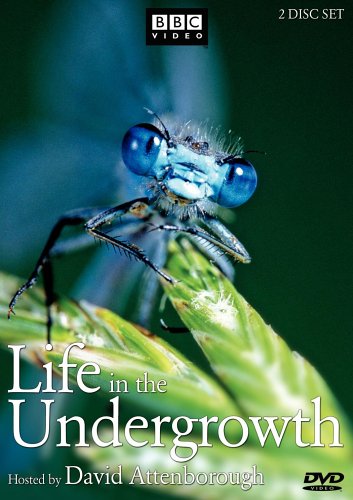
10 Reasons to Rent "Life in the Undergrowth"


Rent it! D. and I just watched the last episode a few weeks ago. It is amazing. It was far too short, in my opinion, for all the diversity of creepy-crawlies out there, but it was nonetheless an astonishing nature documentary.

There are actually eleven good reason to rent it. Check out these ten video clips that the producers considered the highlights of the series.

(Don't worry, they're short, but if you're really pressed for time, the slugs mating, the feather-legged bug, and the titan beetle are my favorites. Oh and the bees. Check out the bees!)

The eleventh reason? This man:

Sir David, with friend.

Sir David Attenborough -- do you need any more reasons to watch anything? Go rent it now! I know for sure that Netflix has it. Enjoy!