Showing posts with label vegetarian life. Show all posts

Wednesday, January 14, 2009

Results Show & Tell

Homemade, fresh ricotta is really, really good.

As per my previous post, I followed the recipe for fresh ricotta. It took a little longer to drain than I anticipated, but the results are rich and creamy, with just a fresh taste of milk and no weird stuff. Here is a step-by-step photo-safari of the process.

The ingredients, and most of the equipment. Not shown: stirring spoon, measuring cup, cheesecloth.

Heat the milk until it simmers, steams, and bubbles on the edges.


Buttermilk ready to go.


After adding the buttermilk, continue heating and stirring constantly until it starts to look a little weird. Those are the curds forming. Next stop, cheese!


Pour everything into a colander lined with cheesecloth. The whey goes down the drain, or into a bowl if you want to hold on to it.


About half of the final product still in the colander. After an hour of draining, it was very thick and creamy. (I moved it to a bowl to free up space in the sink.)


The final product (atop the recipe). 1/2 gallon of milk + 2 cups buttermilk = about 1 pint of ricotta cheese.

I recommend eating it straight from the container with just a little honey and a pinch of salt, or just piled up on a piece of sourdough bread with a little salt and pepper. Next time I might try pressing it to form something like feta or mozzarella, but for now I'm going to sit around and feel pleased with my homemade cheese.

Tuesday, January 13, 2009

DIY Dairy II: The Curdling

A while back, I talked about my interest in making my own yogurt.

Tonight, I'm going to try a new experiment: I'm going to make my own cheese.

As before, you may have your doubts, reminding me that caves are often an integral part of the cheese industry and that I live in an apartment (and not a very cave-like one, at that).

But Mr. Bittman says it can be done at home, and quite easily. And, I have an important ingredient: motivation. When I lived in Manhattan, I had the world's best sheep milk ricotta available whenever I wanted it from the Fairway cheese counter. I remember the first time I tried it; I had asked the cheesemonger on duty where I might find the ricotta, and he said to me, "Well, that Polly-O stuff and all the others are around that corner, but... try this." He produced a spoonful of the creamiest, lightest, most delicious ricotta I had ever tasted. (They kept it behind the cheese counter, available only by request.) I made a fine baked pasta that night, and every bite was a song of praise to the sheep that had produced the milk. That ricotta tasted of excellent milk, open green pastures and fresh air. Polly-O and all the others, after that, only tasted like processed, fake food.

Sadly, I do not currently have a source for this miraculous ricotta. When the farmer's market season fires up again I will be able to get some, but I have a tomato-blue cheese tart planned for Thursday and I need some good ricotta today.

Which is why I am going to make my own cheese.

The basic principle of cheese-making is this: if you start with milk and add something that acidifies it, the proteins will stick together in clumps (curds) and separate from the liquid (whey). Strain the whey from the curds, press them together, add salt and other flavors. Age as you see fit. A simple process in principle, but with lots of room for improvisation.

When you acidify the milk with an acid, you get something like feta or cottage cheese. However, most cheeses are made at least in part with the help of our friends, the bacteria. Bacteria break down the sugar in milk (lactose) and turn it into organic acid (lactic acid). This acid then causes the reaction I described above. You already know this if you have encountered milk that is very far beyond its expiration date; it smells sour and gets a bit clumpy at the bottom.

The recipe Mr. Bittman gives calls for buttermilk, which is made by innoculating milk with a bacterial culture, similar to a very thin yogurt. (Historically, buttermilk is what remained after skimming the milk to make butter, but that is rarely available in your average supermarket today.) The milk is simmered for a few minutes, the buttermilk is added all at once, and, with a little luck, everything will curdle nicely. The whole mixture is put through a cheesecloth, salted, and drained.

I will let you know how it goes tonight in my laboratory kitchen. I'm using cow milk, since sheep milk is not available at Stop n Shop. In the meantime, check out the Wikipedia page on cheese. Interesting things to know:
  • The history of cheese predates recorded history.
  • Acid-set cheeses (as opposed to rennet-set) will not melt; they have a different kind of protein matrix holding them together and only get firmer as they cook. (Paneer is a good example.)
  • The US is the world's biggest producer of cheese, but France is the biggest exporter. But the true title of cheese-eating champions goes to Greece, which eats more cheese per capita than any other country. (However, three quarters of it is feta cheese.) France is a close second.
There are a lot of things I didn't talk about here that relate to cheese making, including rennet and fungus. While I would like to discuss them in the future, I won't be using either in my cheese-making attempts tonight, so I will have to leave them for another time.

PS: A little late, but... Happy New Year!

Monday, December 15, 2008

Plants Fighting Back

On Tuesday I reached into the container of cilantro from the grocery store and quickly pulled my hand back in surprise. Something had hurt me! But what?

My thoughts went to some alarming places. Bits of metal? Shards of glass? I felt like I had been pricked by something sharp, but there were no marks on my fingertips. No blood was drawn.

I dumped all of the cilantro into a colander and moved it around with a fork. There in the middle was the culprit. Initially its camouflage had concealed it from sight, but on closer inspection it stood out from its surroundings.


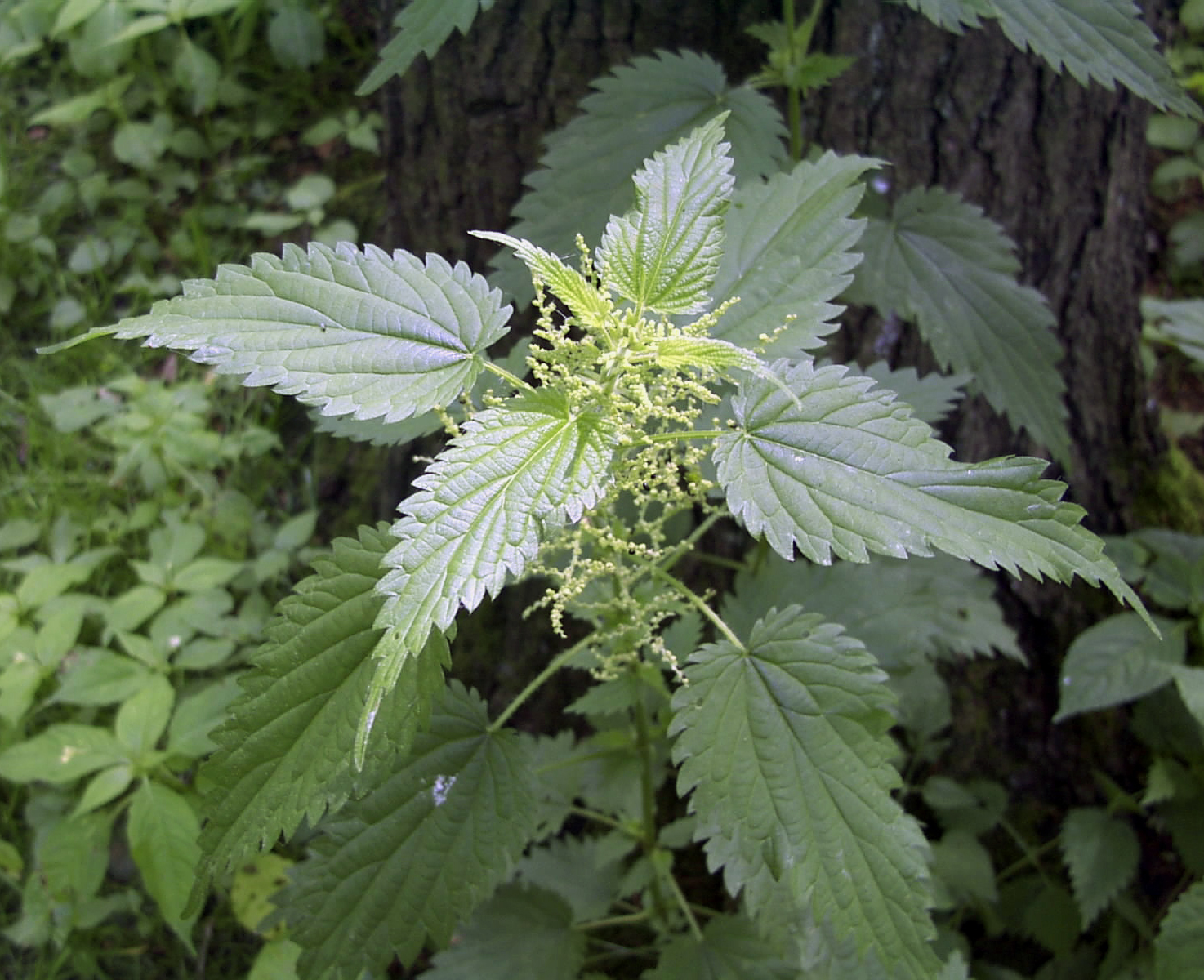
Clearly, those are not cilantro leaves. Any guesses?

It turned out my instinct was correct, because the first page I pulled up on Wikipedia was stinging nettle, where I saw the above picture. The plant mixed with my cilantro was the spitting image.

What makes a stinging nettle sting? The sting is caused by a combination of chemicals, not just by the hairs alone which, although sharp, are tiny. Tiny and hollow, and filled with a combination of chemicals that give a noticeable irritation: acetylcholine, serotonin, and perhaps most importantly, histamine and possibly formic acid. Yikes.

Surprisingly, nettles are easily tamed, and can be made into tea or even eaten when young ( and cooked). They're also good for your hair, feature prominently in hippie-dippie shampoos, and are mixed into cattle feed to give the bovines shiny coats. My nettle, however, was transferred by fork to the trash bin, as I was in no mood to attempt to tame it. (And my hair is already quite shiny, thank you.) I do admire it for fighting back, though. As a vegetarian, I'm not really used to food that puts up much of a struggle, so this was an interesting interaction between me and a plant.

But I think I'll stick with cilantro just the same.

Wednesday, September 17, 2008

Super Supper?

People who know me well are often inclined to ask my opinion about whether something is "good for me." It's an interesting question. I'm not really qualified as a nutrition scientist, food chemist, doctor, or, you know, any other professional food expert. I am a vegetarian, which has made me more aware of what I eat (and more aware about myths concerning protein, for example) but other than that, and being a voracious reader and an enthusiastic Pollangelical, I'm just an ecology graduate student.

But, usually, I have an answer. It's generally along the lines of, "Well, is it a plant? If it's a plant, eat it. If it's not a plant, just eat a little of it." For more information, I turn to the trusty rules of Pollan: does it have more than five ingredients? (Bad.) Are any of them unfamiliar? (More bad.) Are any of them unpronounceable/indistinguishable from the ingredients in your shampoo? (Very bad!)

Now, though, there are new problems. Foods that used to be totally normal foods have become... something else. Do you like sardines, for example? (Many people don't.) What if you couldn't taste them, and they were in your orange juice this morning? Would you like to have some broccoli, kale and beet salad? (Not too appetizing?) That's OK, you can get all your vegetables in a convenient chocolate bar form!

Weird, right? And yet... and yet. Superfood or Monster from the Deep?

So is that chocolate-broccoli-kale-beet bar good for me?

I hope no one asks me, I'm not really sure what to say. I'm pretty sure the answer is, "Well, it's still a chocolate bar!" but what does that even mean any more? What if it supplies all the daily requirements of certain things? I can tell you that eating a square of chocolate will not fill you up, and you'll still want a normal meal. I can tell you that if the rest of your diet is made of burgers and fries, having some antioxidants in your chocolate is probably not going to help you much.

What about having orange juice with sardines in it? Even assuming a negligible flavor difference, shouldn't orange juice have, you know, just one ingredient?

Thoughts from the gallery? I'm moderately sleep-deprived, so let me know if I lost you somewhere along the way.

Wednesday, August 13, 2008

Applebee's, Redux

On Monday evening, as I was preparing dinner, I received a telephone call.

It was from Applebee's! (Read my previous post on Applebee's here.)

Specifically, a very nice manager of the location at which I recently dined who made the following points:

1) The "artifact" (their word, not mine) had been promptly removed and destroyed. Or at least put in the trashcan, good enough for me!

2) As a lapsed vegetarian, she had a lot of sympathy for the fact that when I look at the menu, even though I know that something could be made specially for me, I feel slighted by the 100% coverage of meat. I expressed this feeling and suggested that even listing a few things, like vegan burgers, black bean and veggie quesadillas, and maybe a pasta primavera with a choice of sauces could really add veggie comfort to the menu. She thanked me for the suggestions and gave me her email address in case I think of more/better ideas. (Since I was preparing dinner at the time, my brain wasn't entirely focused on coming up with *other* meals, one at a time please!) I haven't contacted her yet, been busy with the dragons, but I will soon.

(Any suggestions?)

Anyway, I have to say that this experience with Applebee's has been on the whole very pleasant and positive. It's nice to know that companies really take the words "customer service" seriously. So far I'm three for three in my interactions with food businesses this year, kind of awesome! Hopefully, if they're really serious about it, we'll start seeing more veg-friendly fare on the menu at your local Applebee's too. One location at a time, I guess. Where better to kick things off than the Garden State?

Wednesday, August 6, 2008

I Want to Go to Nice

This restaurant sounds amazing!

Rich, Luxurious, French, Vegetarian

The only thing is, where did Mark Bittman get this idea that people need to be convinced that veg doesn't equal monastic? Guacamole, peanut butter and tahini are all vegan and all decadent, and when you're ovo-lacto the whole world of cheese, eggs, and therefore soufflé is at your disposal. So, I'm not really sure where that came from, or who he's trying to convince. After all, he did write How to Cook Everything Vegetarian, so he knows better... it's very odd how defensive he is.

But if you're up for a trip to Nice (and who isn't?), let me know, we're going to this place.

Sunday, August 3, 2008

Applebee's, Meat, and the Dearborn Independent

Today D. and I went to the local Applebee's for a quick bite after doing some shopping at Target. We don't eat there often, but it was close by and we figured it would be fast and easy, and it was.

While we were waiting for the check, I idly surveyed the sports memorabilia decor. Jets jerseys sharing a wall with Giants jerseys, an assortment of hockey team photos, and along one wall, a number of humorous golf-related signs.

And then my eyes fell on something unusual on the wall of golf items. For there, between the sign indicating that hitting your caddies with a five iron is more effective than with a driver (or something like that, it seemed very violent either way) and something else about golf being outlawed in fifteenth-century England, there was a little framed magazine cover showing a man in classic golf pose, having just driven the ball 200 yards and looking very satisfied.

It was a cover from the Dearborn Independent.

Had I been in this Applebee's a year ago, I might not have even made any association, although the name was certainly familiar. However, over the last couple of months D. and I have been watching The Jewish Americans, a great documentary that aired in three 140-minute segments on PBS. It's really good so far, although I haven't yet wanted to watch the next segment. Learning about Jews in the Old West is one thing, but we're just about up to World War II and that's a little harder.

In the meantime, though, we have learned a lot about Henry Ford and the newspaper he purchased that published some genuinely bonkers anti-Semitism. Among other things, it ran the Protocols of the Elders of Zion.

The Dearborn Independent was founded in 1901 and purchased by Henry Ford in 1919; it didn't publish again after 1927, after lawsuits about above-mentioned bonkers anti-Semitism forced him to shut it down. The cover in the restaurant was dated 1926, putting it squarely within his era.

I'm not calling for some kind of mass action against Applebee's; restaurant chains have enough going on right now with the economy doing what it's doing. But it did get me thinking. I had actually been planning to email the company anyway; the menu is dreadfully dead-animal centric, although, as our waitress helpfully pointed out since it wasn't on the menu, they do serve vegan burgers. I think I will mention the magazine cover in my email as well. I know that their intention was not to offend; I'm sure it's only up on the wall because it fit the golf theme of that section. But I do think it's worth reconsidering whether it should be up there at all.

What do you think?

Thursday, July 31, 2008

You Say Xitomatl, I Say Tomatillo

Tonight I cooked tomatillos for the first time.

I suspect that most of my regular readership knows at least vaguely what a tomatillo, also known as a husk tomato, is, but just in case, these are tomatillos:

Physalis philadelphica

They're green and tart, and from what I can tell, their primary use is making salsa verde.

They're also great for confusing cashiers at the grocery store. Apparently, in New Brunswick tomatillos are purchased so infrequently that they were not in the computer system; a manager had to trek to the produce aisle to find the price.

It's too bad, because they're absolutely delicious. I took a bite of one before cooking, out of curiosity, and found it very pleasant. It was tart, yes, but flavorful and not overwhelming. It didn't make my face screw up the way it does when I lick a lemon; it was more like the pleasant tartness of a granny smith apple (which it strongly resembled visually) without any of the sweetness.

The dish I was making was not salsa verde, but it may as well have been. It was basically a souped up version of salsa verde, with lots of pureed corn, peas for extra green color, and for no discernible reason, canned green chilies. (That's what was in the recipe, and I like to follow recipes one time through before I fix them up.) Next time I make it, no cans necessary -- the jalepeños, for some reason, are thriving on our balcony and we should have a nice harvest starting soon. (It will add some heat, too -- the soup could use a little more hot pepper.) I can say with some satisfaction, however, that I used home-made veggie broth for the first time, with outstanding results.

Anyway, back to the tomatillo.

Tomatillos are in the nightshade family, although they are in a different genus from tomatoes. An interesting fact from Wikipedia is that tomatillos are self-incompatible; that is, you need at least two tomatillo plants to get any fruit. Whole Foods, meanwhile, indicates that they can be used to tenderize meat, probably due to their acidic content since it doesn't mention anything about our friends the enzymes.

According to Purdue, evidence of tomatillos has been found at the site of Tehuacán in Mexico, although they give a date range of 900 BCE to 1542 CE, which is not terribly helpful. (A lot can happen in 2100 years!) They do add that in pre-conquistador Mexico, the tomatillo was actually preferred over the tomato. (I would have to guess that their European visitors did not share this opinion, because we do not eat spaghetti and meatballs in salsa verde.) There was also, apparently, a lot of confusion about exactly which fruits were which, because Aztec words got a little mixed up by the Europeans.

GourmetSleuth, however, seems pretty sure that the domesticated tomatillo dates back to at least 800 BCE. They also have information that's a bit easier to read about the whole tomato-tomatillo-tomatl-xitomatl-miltomatl controvery. (Dang, now I wish I spoke Nahuatl. Apparently "tomatl" means approximately "round and plump", so that's a word I can get behind! Also, these are the same folks who gave us chocolate.) They also agree with Whole Foods that tomatillos freeze well but should be frozen whole.

So there you have it, the tomatillo in a nutshell. Or in a tomatillo husk, as the case may be.

The moral of the story: go buy some tomatillos and eat them, cook them, make salsa verde, confuse cashiers. I think they'd probably make an interesting margarita, too. Too bad I cooked all the ones I got today.

Saturday, July 5, 2008

DIY Dairy

In the spirit of reducing packaging from foods (is seltzer a food? maybe in Hollywood?) that I love, consider the yogurt maker.

"But dairy products were not meant to be made at home!" you might think. "They are frequently complicated, sometimes involve caves, and are generally not DIY projects!" Ah, but that is not always true. Yogurt is actually incredibly easy to make at home; technically, you don't even need a yogurt maker, but having one can greatly improve the reliability of your results. (And as a scientist, I am always in favor of reproducible results.)

Yogurt is delicious but also tends to arrive in non-recyclable plastic containers, creating even more guilt than recyclable seltzer bottles. (Yes, in some places you can recycle plastic #5, but for whatever reason, those places don't include New Jersey.) It also tends to come in fairly standard flavors, like peach and blueberry. Making yogurt at home allows you to create your own flavors. If I get a yogurt maker at some point in my life, I might start with herbal or spiced yogurts (lavender? thyme? cumin?), maybe play with extracts... cherry-almond is one of my favorite combinations, so a little almond extract (or even almond milk?) might be a tasty addition. We'll see how it goes.

Monday, June 9, 2008

Bagels and... what?

Hmm. Zabar's will have their hands full trying to make sardines the new lox. Good luck with that.

Sardines with your bagel?

Despite what seafoodwatch.org might say, salmon is probably best to just keep on your Avoid list. I'm not sure how recently they updated the list, but it probably hasn't been updated since the Pacific fisheries south of Alaska were closed. With prices on Alaskan salmon poised to go through the roof, you might want to find something new to put on your bagel.

Unfortunately, the other classic bagel topper, whitefish, is also a no-go. Atlantic cod, aka whitefish, is a big red Avoid on that list. But if you're a fan of herring in cream sauce, you're doing A-OK, since herring (aka sardines or kippers) are considered a Best Choice.

Of course, the other option is to not put any fish on your bagel at all. I like mine toasted with a little butter, tomatoes, and a slice or two of manchego. Simple, delicious, and definitely dolphin-safe!

Saturday, May 31, 2008

You say CAFO, I say IFAP...

The Pew Charitable Trusts and the Union of Concerned Scientists have published reports that say that our current animal husbandry system is inhumane, inefficient, and disgusting.

Yeah. We already knew that, but it's nice to have confirmation from people with recognizable names!

Yesterday I went to the Rutgers Farmers' Market (I'm not really sure what to do with that apostrophe, by the way; anyone have a suggestion? If multiple farmers are selling things, it goes at the end like that, right?) for the first time. The produce selection was limited, but one item was in abundance: meat. There were bison steaks and burgers, chickens -- whole, deboned, sausaged -- quail, maybe even lamb, I don't remember exactly. Locally and humanely raised, the whole lot of it. I wish it were as simple as "stop eating meat" but if that's not really the way you want to go, check out your local farmers' markets; you might be surprised at the variety of non-vegetable foods available to you. (I'll get some links to the NJ ones up soon.)

Friday, May 16, 2008

Small Farms Are Delicious!

Surprisingly, the crux of this post isn't "don't eat meat." Just read this: Change We Can Stomach.

Today's post is brought to you by the letter "buy local" and the number "support small family farms."

Best quote:
In fact, small farms are the most productive on earth. A four-acre farm in the United States nets, on average, $1,400 per acre; a 1,364-acre farm nets $39 an acre.
How about that statistic? Check out the link to Local Harvest under "Favored Links" to find a farmers' market near you! Mm, delicious produce. Oh, also, go to sites like AllRecipes.com to find delicious ways to use all that wonderful produce. Farmer's market season is only just beginning, but I'm already fantasizing about just-picked tomatoes. Hopefully I'll have pictures of my own garden up soon, but I haven't had a chance to upload them.

On a related note, you might want to check out this pocket guide to the best foods to buy organic. Of course, you should get organic as much as possible, but if you have to decide (since organic is still more expensive), this guide will help you get the most organic bang for your buck. (At the moment this link isn't working, but hopefully they'll fix whatever issues they're having soon.)

Thursday, May 1, 2008

Food, Food, Food

Food is so hot. Food is one of the reasons I started a blog. Yet I haven't been posting nearly enough about it!

There have been two articles in the NY Times worth checking out recently. One is part of a series called "The Food Chain" which is in the business section about the global food crisis and various other food issues. The articles is "Shortages Threaten Farmers' Key Tool: Fertilizer." The long and the short of it, again, is that we should stop eating meat. Really.

The other article actually says that we should eat more meat, assuming that meat is from a heritage breed or other endangered, culturally significant food source: "An Unlikely Way to Save a Species: Serve it For Dinner". For the most part, I agree with the perspective of this article; too many heritage breeds and heirloom varieties are being lost to the uniformity of global food production.

However, I have to take issue with a few of the species they list in the infographic as food supplies worth conserving, including leatherback sea turtles, wild bison and Snake River chinook salmon. They do mention this to a degree in the article, with regards to the flying squirrel (yep, squirrel is on there too), but I just feel like they don't talk enough about the species on here that we need to do a lot more for than just eating them; that, in fact, we might do better for by not eating them at all. I think putting the species on this list at all, although they may be culturally significant, is not going to do them any favors. This is especially true for the poor over-harvested salmon; hopefully no one will look at this article and say, "Well, we're harvesting a heritage food, we'd better keep eating them to conserve them!" Maybe I'm underestimating people, but... I don't know. It's a little disconcerting. Definitely interesting in regards to the fainting goats and the Makah ozette potato, though!

If someone figures out a cure for chestnut blight based on wanting to eat them, that might be wonderful. Seeing a chestnut stump with sad little sprouts is a tragedy.

PS: I have never been to a clambake.

Friday, April 11, 2008

Feeding the World

Right. I said last month that I am not a vegangelical, and I stand by that.

But it needs to be said.

Stop eating meat.

Despite the fact that I am an animal lover, I am not saying this to spare the cute 'n' cuddlies. The simple fact is that we are running out of grain, and eating animals is an inefficient use of grain, and although I sometimes don't like people, it doesn't mean I want a massive food crisis to hit around the globe. It takes 700 calories of grain to produce 100 calories of cow. I don't know about you, but 14% efficiency, to me, is WAY too low.

Some recent reading material:

Grains Gone Wild -- Paul Krugman's editorial from a few days ago.

Farmer's Spurn Conservation Program -- Science/Business Times this week.

First one is straightforward, just read it. Second article... well, do we want to eat or do we want to worry about the birds, as the baker says? Why can't we do both? Cattlemen have the answer:
“This program is taking money out of your pocket twice a day,” said Jay Truitt, vice president for government affairs for the National Cattlemen’s Beef Association. “Do you think it’s right for you to pay so there’s more quail in Kansas?"

The cattlemen and bakers argue that farmers should immediately be allowed to take as much as nine million acres out of the Conservation Reserve without paying a penalty, something they say would not harm the environment.
Of course the cattlemen want more land out of the conservation program, they need it to feed their meat-producing machinery. What if I want to pay for the land in Kansas? It doesn't matter to me if the price of beef goes up, but it does matter to me if there is less land available for our native birds. (And who made a bunch of bakers and cattlemen experts on what would or would not harm the environment? Probably the same group that decided airlines could monitor themselves.)

Further, one of the demands on the food system is that countries that traditionally haven't eaten much meat (looking at you, China) are starting to adopt American-styles diets, full of beefy goodness. So, as though Americans weren't enough of a strain by themselves, people around the world now want to eat the way we do. And there just isn't enough land to support that lifestyle.

We're not going to get any more land. We have one planet, and that's it.

There's really only one solution. Stop eating meat. It's the easiest thing you can do today to save the world.

Tuesday, April 1, 2008

Bacon!

Mmm. What can I say? I love bacon.

The smell of smoked meat... the crispiness of the fat and the chewy meat, the saltiness that's so delicious when combined with a pancake and maple syrup. There is no food more sublime than a plateful of bacon.

Look at the way the meat and fat alternate in beautiful stripes. Notice the gentle undulations of each strip, harmoniously piled together just so to make a veritable sea of smoked pork. If I may quote Pulp Fiction briefly, "Bacon tastes good." Yes! It's true! Bacon is delicious, and there are no two ways about that.

Thursday, March 27, 2008

Vegans, strippers, and feminism

There are a lot of vegans in Portland, OR. Some of them are strippers. Some of them are strip club patrons. Fortunately, someone finely attuned to their needs created an all-vegan strip joint.

Just what we needed...

On stage, you won't catch these ladies wrapped in fur. Or feather boas. Or leather shoes, wool scarves (I don't know what role wool has in striptease, but it's forbidden too), or silk not-much-of-anything. Everything on stage was made without cruelty to animals. You can't get a steak, but you can get a soy taco platter. You might be able to get a Caesar salad, but there won't be egg or anchovies in the dressing.

I'm not going to rehash everything in the article here, since I kind of agree with everyone a little bit in the article. Feminists can be a little too uptight about strippers, while vegans can be a little too willing to show off naked women for publicity. I do think that some of the criticisms of PETA are a little unfair; the very first model for the "Ink, not Mink" campaign was actually Dennis Rodman, who I'm pretty sure is not a woman.

But, I just want to add... I do have a problem with blind following of the vegan ideal, without thought to the consequences. PETA is an animal-rights organization, so that's their thing, and that's fine, but they unilaterally oppose all hunting, all leather, and all use of animal products.

What if hunting is necessary, as it is in NJ? We have too many deer here and although I personally don't find hunting to be the right decision for me, I support people who hunt and eat the white-tailed deer that are threatening our forest ecosystems. I don't like the idea of sport hunting, but it saddens me that PETA paints all hunters with the same blood-red brush.

What about pleather? Is pleather actually better? I used to think so. Then I started thinking about where that pleather comes from. Answer: Probably petroleum. Most plastics do. And where are those pleather pants/shoes/I don't want to know going to end up when you're done with them? Probably a dump, where they will sit. And wait. And wait. Plastics take a long time to break down. Leather obviously doesn't decay quickly, especially since we treat it with additional chemicals, but my instinct tells me that it will break down before the pleather does.

You won't catch me in a mink coat any time soon, but I do have a leather couch. Maybe that means I'm not a feminist? Or that I am? I don't know.

Wednesday, March 26, 2008

More salmon news

Apparently, southern hemisphere salmon aren't doing any better than northern. This time, though, it's farmed salmon in Chile that are poorly. Of course, farmed salmon in general isn't sustainable... they're carnivores, and it takes four to six pounds of other fish to raise a pound of salmon. Where does that fish come from? I don't really know. But it's coming from somewhere in the deep blue sea, and the seas are becoming more and more empty. Plus, farmed salmon in areas where salmon normally live can intermingle with wild populations, spreading both diseases and genetic material and contaminating the wild fish. When it comes to salmon, wild caught is still the best. Oh, and did I mention that these (in the article) are Atlantic Salmon? That are being farmed in Chile? Where they don't belong in the first place? And that some of them are escaping and eating the native sea life? Yeah. Bad situation all around.

By the way, the article specifically mentions Costco and Safeway as retailers that sell Chilean salmon. Don't buy it, and let them know why!

My neologism

I'm definitely not a vegangelical. That sweet little neologism is a recent addition to the Urban Dictionary, but I am not one of the ranks of that holier-than-thou crowd. I'm happy to say I don't know too many vegangelicals, actually. The vegans I know are a modest bunch, for the most part.

But I realized that I do have a higher calling, even if it isn't being a vegangelical. I encourage everyone I know to read the good book I follow, to live their lives by a simple mantra, and to bring mindfulness to everything. (Especially eating.)

Ladies and gentlemen, I'm a Pollangelical.

Eat food. Not too much. Mostly plants. (All the rest is commentary.)

Amen.