Thursday, April 10, 2008

Two Stories, One High School Student

Matthew LaClair is a troublemaker.

Last year, he brought a law suit against his high school (in New Jersey!) for a history teacher's utter failure to make the separation between church and state in the classroom. He secretly taped the teacher saying things like, "only Christians had a place in heaven, that the Big Bang and evolution theories were not scientific and that dinosaurs were on Noah’s Ark." (Did I mention that I live in New Jersey too?)

Other than the fact that I'm still getting over this sort of thing happening in New Jersey (!), there are two sentences I find alarming in this article. First: "After the tapes became public, Matthew received a death threat and was shunned and bullied by some of his classmates, he has said." Wow. It's unbelievable to me that his actions would actually be cause for people to shun someone. If this had happened in my high school, I'm pretty sure we would have thrown him a parade.

Second: "In the fall, the board reprimanded the teacher and later adopted a policy barring students from taping in class without a teacher’s permission." I find this vaguely unsettling. What if another teacher is saying wildly inappropriate things in the classroom? How can students prepare themselves to keep church out of school if the school makes rules against what Mr. LaClair did? Very shady if you ask me.

Anyway. Sometimes you don't need a tape; the evidence is already written down and published.

You can't keep a good rabble-rouser down, and he's causing some more trouble in history class. This time, his beef is with a textbook that plays down the causes and impacts of global warming. (For example, although millions of people might lose their homes as coastlines are flooded, they won't have to pay as much for heating! Yay!)

Whether you agree with him or not, this guy deserves a lot of credit for standing up to The Man. Freethinking is not taught in most high schools; anyone who comes away with that particular skill is likely to be self-taught. Mr. LaClair, I salute you.

Better Know an Arthropod: Giant Isopod

Have you ever turned over a rock and watched the little creatures that go scurrying away? Under your average rock in New Jersey you'll probably find a centipede or two, a millipede, a variety of insects like ants and beetles, and a few rolly-pollies. Pillbugs. Woodlice. Whatever you want to call them, they're sort of cute, greyish little things that roll up in a ball if you poke at them.

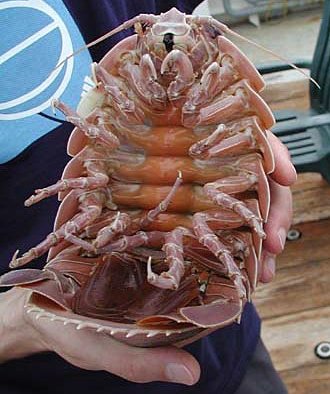
Imagine, if you will, what that would look like if it were light purple, 14 cm long, weighed over a kilo and a half, and lived in the ocean.

Turns out, you don't have to imagine too hard. It would look like this.


What does a beastie of such proportions eat, you might wonder? Fish? Octopi? CHILDREN?

Nah... they're noshers.


Apparently, in Taiwan they're served in restaurants and taste like crab. EXTREME CHEESE flavored crab, in this case.

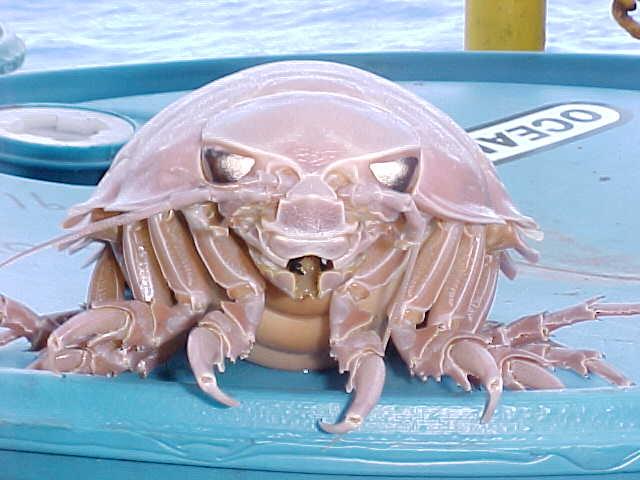
They're pretty much harmless to humans, being slow-moving deep-sea scavengers and all, but you should avoid looking them directly in their highly reflective, compound eyes.

Not photoshopped!

They can see into your soul, and they will know if you are hiding Doritos from them. Oh yes, they will know.

PS: If you want a t-shirt featuring a giant isopod, get one here! (Third one down.)

Tuesday, April 8, 2008

Cute Animals!

Really! Cute animals! Awww... who doesn't love an adorable hippo? No insects in this post, I promise.

Better Know an Insect: On Second Thought...

You really don't want to better know these.

Actually, stay as far away from them as you can.

Cracked.com: The Five Most Horrifying Bugs in the World

I have to kind of agree with them on all counts, too. Notice how all but one are hymenopterans.

Saturday, April 5, 2008

Better Know an Insect: Beatrice

Meet Beatrice. Beatrice was truly an exquisite little creature. She is surely gone to the great garden in the sky now, but she lived in a tank (ok, actually a file box) in our apartment for three days last October.


For my insect anatomy & physiology class, we had to collect some insects for dissection. I had already caught more than I needed (I still have some of the insects I didn't use in a jar on my desk, to remind me not to take life needlessly) when I found Beatrice hiding in a tangle of vines.

She was so astonishingly beautiful (even if her kind is an invasive species) that I knew I couldn't let my classmates find her. I borrowed a jar to keep her in and brought her home with me instead.

I tried to make her comfortable in a file box full of plant matter. (She coordinated with it beautifully.) I fed her whatever insects I could. Strangely, although we almost never get insects besides fruit flies in our apartment, while Beatrice was with me I found two large shield bugs on the screen door to our balcony. I fed both of them to her. She seemed to like them.

Watching her eat was one of the most amazing things I have ever seen. (Including the time I saw a snake eat a mouse while hiking in New Mexico!) Mantids are ambush predators, so she would hold very very still and orient towards her prey, whether it was a stink bug, an injured satyr butterfly, or any of the other prey I supplied. Watching her triangular head turn to face her prey could have been science fiction. Once she was within striking distance, her forelegs would shoot out, delivering a crushing blow with the sharp spines on the inside of the grasping section. Then she would eat.

I could write poetry about the delightfulness of insect mouthparts. Humans are so limited. We have a single jaw that goes up and down. With a little thought we can go side to side, a bit. And that's it. Insect mouthparts are derived from appendages, which is why they come in pairs. Several pairs, actually. In addition to the mandibles, which are often the most visible, they have several other pairs that taste the food, help process it, and push it into the opening of the mouth. They are complex, tiny, and fascinating to watch.

Mantids are what we technically call "chewing" predators, which is to say, they eat the whole damn thing, exoskeleton and all. ("Sucking" predators turn the insides of their prey to soup and suck it out through straw-like mouthparts, discarding the exoskeleton when they finish; the true bugs do this.) Beatrice took dainty little bites (owing to her mouth being relatively small for her body) but she was certainly quick. Watching her eat a caterpillar reminded me of how I would approach a baguette, if no one was looking: hold it in both hands, take a big bite out of the middle, and eat through the middle first. Chew up one side until it was gone, then the other. Lick fingers.

Beatrice was as fastidious as a cat. After eating, she would meticulously groom every spine on her grasping legs. She even cleaned her eyes at one point (possibly after the butterfly, which no doubt covered her in little wing scales).

Eventually I felt that I couldn't keep Beatrice indoors any longer -- not when October was continuing in such glorious fashion. I returned to the garden when we first met and set her down on a patch of flowers, knowing that visiting bees and butterflies would supply her with plenty of food. I wanted her to live out her last week or two in her natural habitat, so that next spring there will be more baby mantids out there to find.

Thursday, April 3, 2008

Better Know an Insect: Hissing Cockroach

As promised, more critters!

This beauty is a Madagascar hissing cockroach. This one is a male. I borrowed him and a female (henceforth "Hissy" and "Missy") from my friend Eugene earlier this semester for a class project.

You can tell this little guy is a male by the large horns (bumps) on his pronotum. (The pronotum is the part that looks like a shield over his head.) Females are much smoother.

As you might expect for something that is roughly snack-sized for a lot of creatures, hissers are not fond of being lifted. When you pick them up, they flatten against the ground as best they can and expel air through a series of tubes in their abdomens. This creates a loud hissing sound -- and even when you expect it to happen, it can still startle you! Missy wasn't particularly prone to hissing -- I couldn't get a peep out of her -- but Hissy up there was not fond of being lifted and hissed at me repeatedly before I got him up.

Once you pick them up, though, they're very happy to sit for pictures. (I suspect that they liked how warm my hands are; they're tropical and my apartment doesn't frequently reach 85 degrees!) Their legs are strong and they can hold on to almost anything. Eugene says that they can climb glass, and I definitely saw them climbing the walls of their plastic tanks.

They also constantly test the air. In the photo you can see that Hissy's antennae are blurry; that's because he was moving them constantly despite the rest of him being completely still. It's important for potential snacks to know what's going on!

I hope you like my hisser photo. Tomorrow I'll post some pictures of Beatrice.

Wednesday, April 2, 2008

Mammal-centrism

It bothers me. Yeah. That's right. I'm tired of cute, fuzzy, cuddly critters. (Except that saiga antelope. Man that thing is crazy looking!)

Vegetarian Times has put its April 2008 edition online as a free trial of online magazines, which is actually pretty cool, except that you can get all of their recipes online anyway. (Part of the reason I stopped subscribing.) But the image that goes with the article on p. 68 really irks me. The article is called "Eat for Change" and that's all well and good, but there are way too many mammals. Aside from the female human in the picture, there is a rabbit (which looks like a white lab rabbit, including makeup!), a skunk, a deer, and a squirrel (also wearing makeup, apparently this is the one Eddie Izzard met). There are two birds and two butterflies.

Ugh.

I realize that my idea of "cute" might not be the same as anyone else's (yes, I did bring home a pair of cockroaches one time, and yes, I did start to find them sort of adorable) but what about, at least, other attractive vertebrates? There are some lovely lizards and fishies out there, not to mention the sheer cuteness of frogs.

But even including more vertebrates is, well... besides the point. We're the minority, folks. The insects have us, tarsi-down. There are more species of beetle than there are of vertebrates several times over. More than half of known animal species are insects.

For the rest of this week, and all next week, I'm going to post about interesting insects and other non-vertebrates. Let's call it "Get to Know Your Neighbors" week-and-a-half. Interesting critters live all around us, if we're open to seeing them. For example, leaf-cutter ants mostly live in the tropics, but one species lives as far north as New Jersey! I'll write more about leaf-cutters in a post of their own, though -- those minuscule farmers deserve it.

In the meantime, here's a picture of a pair of frangipani hornworm (aka tetrio sphinx moth) caterpillars that I took in St. John.


My hand is actually right next to that caterpillar; I am not using Peter Jackson's camera techniques. They grow to be six inches in length and can eat up to three leaves a day; one clutch can defoliate a frangipani (plumeria) tree in very little time. They might look fat and succulent, but I wouldn't recommend eating them; some of them sequester toxins from their food sources. However, another theory is that they're also mimicking the coloration of a coral snake, which is highly venomous. Either way, they're pretty spectacular larvae! (You can see the little horn on their abdomens in this picture; it looks like a little hair.)

Enjoy the hornworms. More insects tomorrow!

Chatham cod

Before I launch into this post, I just want to clarify: I do not eat bacon (or any other meat for that matter), and I do not want a gas-guzzling atrocity like a stretch Hummer as my wedding transportation. Check the date stamp, people. NEVER trust anything I tell you on April 1.

Today being April 2, however, feel free to believe away.

I don't know why the Times hasn't just combined the Dining & Wine section with the Science section. It seems like every week there are new articles about food and ecology, which, of course, are basically the same thing. (You said so yourselves, in my poll last week.) Last time it was salmon trouble. This week, it's cod and herring.

This is a cod. They don't start out as fish sticks.

Not a lot of new things to tell you about here. Same old story: we caught too many fish, the stock plummeted, we stopped catching them, they're doing better but still not great, and part of the problem is that we forgot to take into account that no species of fish exists in a vacuum. We (humans) are particularly fond of fish that eat other fish, so when the numbers of the prey fish drop, so do the ones we like to eat. Yay ecology.

Tuesday, April 1, 2008

Wedding Transportation

For our wedding next June, we'll definitely need some transportation for the wedding party. Limos are so old-fashioned; what I really want (and since I'm the bride I get what I want!) is something that says, "We're young, we're fun, we know how to party!"

What ride could say that better than this?

I even like the zebra stripes; it definitely lets you know that I'm both a nature lover AND a party animal! (See what I did there? Ha!) But seriously, this thing would be great for a safari, I bet lions would come up to it and try to take a bite, and then we'd get some excellent closeup photos. But anyway, it would also totally coordinate with the men's tuxes and stuff. Yeah!

Bacon!

Mmm. What can I say? I love bacon.

The smell of smoked meat... the crispiness of the fat and the chewy meat, the saltiness that's so delicious when combined with a pancake and maple syrup. There is no food more sublime than a plateful of bacon.

Look at the way the meat and fat alternate in beautiful stripes. Notice the gentle undulations of each strip, harmoniously piled together just so to make a veritable sea of smoked pork. If I may quote Pulp Fiction briefly, "Bacon tastes good." Yes! It's true! Bacon is delicious, and there are no two ways about that.