
The Pew Charitable Trusts and the Union of Concerned Scientists have published reports that say that our current animal husbandry system is inhumane, inefficient, and disgusting.
Yeah. We already knew that, but it's nice to have confirmation from people with recognizable names!
Yesterday I went to the Rutgers Farmers' Market (I'm not really sure what to do with that apostrophe, by the way; anyone have a suggestion? If multiple farmers are selling things, it goes at the end like that, right?) for the first time. The produce selection was limited, but one item was in abundance: meat. There were bison steaks and burgers, chickens -- whole, deboned, sausaged -- quail, maybe even lamb, I don't remember exactly. Locally and humanely raised, the whole lot of it. I wish it were as simple as "stop eating meat" but if that's not really the way you want to go, check out your local farmers' markets; you might be surprised at the variety of non-vegetable foods available to you. (I'll get some links to the NJ ones up soon.)
Saturday, May 31, 2008


Friday, May 30, 2008
Guano
There was about a week there with no posts; sorry about that. I was busy, and there was Memorial Day weekend, and it took a few days to get myself back together.
This article, in two short pages, manage to cram in a lot of interesting information about colonialism, the pre-petroleum world, sustainable fishing, sea bird conservation, organic farming, and other topics.
Peru Guards its Guano as Demand Soars Again.
Guano is bird droppings; colonial birds such as the cormorants and boobies mentioned in this article produce a lot of it every year. Before humans figured out a way to make synthetic fertilizer (leading to corn that is grown with petroleum, which doesn't really help us when you make it into ethanol), guano was the richest soil amendment you could buy.
What I'm not too clear on is why seabird guano is so particularly sought after. We have millions of captive chickens, turkeys and ducks; can't we use some of their droppings in a similar way? If anyone has a good explanation about this (is it something about the level of fish in the diet?) I would love to hear it.
Anyway, it's an interesting article. It gives a little more insight into just how this massive food chain we've created works. Fish that would go to seabirds are instead going to chickens (which don't normally eat fish); declining seabird numbers means less guano for organic farmers to use on vegetables. The price of petroleum goes up to the point that "conventional" petroleum-based farming is too expensive, so farmers of all stripes are looking for alternative fertilizers.
Thursday, May 22, 2008
Better Know an Insect: Plant-Ants and Ant-Plants
"In the present paper, plants with ants living in them will be called 'ant-plants'; the ants will be called 'plant-ants.' "
~Dan Janzen (1966)
Whatever you decide to call them, myrmecophytes (ant-plants) are an interesting area of research. I recently wrote a term paper on the subject because they came up in the chapter on mutualisms and I couldn't stop thinking about them.
This is a bullhorn acacia tree; similar trees live in the tropics around the world:
This is a South American acacia-ant, Pseudomyrmex ferruginea (sorry, it's sort of blurry):

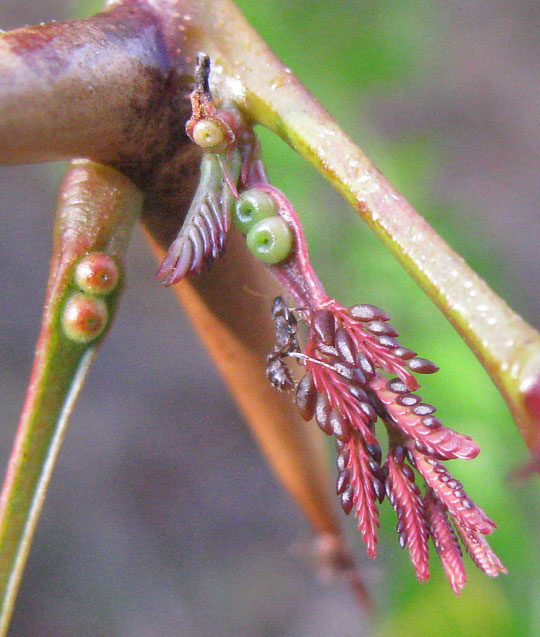
These species need each other to survive. The acacia produces enormous thorns, which a recently mated queen can hollow out to build the first chamber of her colony. She lays eggs and cares for them by using food provided by the plant in the form of extrafloral nectaries (glands on the tree that produce nectar) and Beltian bodies (small blobs of protein that grow at the end of leaflets). As the colony grows, they hollow out more thorns to use as brood chambers and for other purposes.
Sounds great for the ants, but what does the tree get for giving so much? Easy -- the tree gets a standing army, equipped with painful stingers and biting mandibles. The colony of ants protects the tree from all herbivores, both small (they will either kill or carry away any insects that try to eat the leaves) and large (those stings are effective on large mammalian herbivores as well!).
 An African acacia, with large mammalian herbivores.
The ants also act as a landscaping crew. The workers use their powerful jaws to mangle any vines that attempt to climb the tree and destroy any saplings growing within a certain radius. Acacias are susceptible to being shaded out by other trees, so this landscaping is of great importance to the tree's survival.
Mutualistic ants are critical for the tree's wellbeing. In fact, if the ants are experimentally removed from an acacia, the tree is rapidly destroyed by herbivores. (Janzen found this in his landmark study in 1966, the source of the introductory quote.) It is believed that ants have taken over the role of secondary plant chemicals, which normally function as the plants' defense against herbivores. Rather than increasing the toxicity of their leaves, this group of acacias has lost their secondary chemicals and have gained instead a standing army.
This relationship has, not surprisingly, been parasitized by closely related species of ants. You can learn more about this, and the role that large herbivores play, in this video.
There's a lot more to tell about this relationship, but this post is getting long. I wrote a term paper on it, so let me know if you want more ant-plants and plant-ants!
Links: More photos of acacias; "Weird Plants"; a webpage comparing the symbiosis between ants and plants to a nuclear reactor (welcome to the Internet!).
~Dan Janzen (1966)
Whatever you decide to call them, myrmecophytes (ant-plants) are an interesting area of research. I recently wrote a term paper on the subject because they came up in the chapter on mutualisms and I couldn't stop thinking about them.
This is a bullhorn acacia tree; similar trees live in the tropics around the world:
This is a South American acacia-ant, Pseudomyrmex ferruginea (sorry, it's sort of blurry):
These species need each other to survive. The acacia produces enormous thorns, which a recently mated queen can hollow out to build the first chamber of her colony. She lays eggs and cares for them by using food provided by the plant in the form of extrafloral nectaries (glands on the tree that produce nectar) and Beltian bodies (small blobs of protein that grow at the end of leaflets). As the colony grows, they hollow out more thorns to use as brood chambers and for other purposes.
Sounds great for the ants, but what does the tree get for giving so much? Easy -- the tree gets a standing army, equipped with painful stingers and biting mandibles. The colony of ants protects the tree from all herbivores, both small (they will either kill or carry away any insects that try to eat the leaves) and large (those stings are effective on large mammalian herbivores as well!).
An African acacia, with large mammalian herbivores. The ants also act as a landscaping crew. The workers use their powerful jaws to mangle any vines that attempt to climb the tree and destroy any saplings growing within a certain radius. Acacias are susceptible to being shaded out by other trees, so this landscaping is of great importance to the tree's survival.
Mutualistic ants are critical for the tree's wellbeing. In fact, if the ants are experimentally removed from an acacia, the tree is rapidly destroyed by herbivores. (Janzen found this in his landmark study in 1966, the source of the introductory quote.) It is believed that ants have taken over the role of secondary plant chemicals, which normally function as the plants' defense against herbivores. Rather than increasing the toxicity of their leaves, this group of acacias has lost their secondary chemicals and have gained instead a standing army.
This relationship has, not surprisingly, been parasitized by closely related species of ants. You can learn more about this, and the role that large herbivores play, in this video.
There's a lot more to tell about this relationship, but this post is getting long. I wrote a term paper on it, so let me know if you want more ant-plants and plant-ants!
Links: More photos of acacias; "Weird Plants"; a webpage comparing the symbiosis between ants and plants to a nuclear reactor (welcome to the Internet!).
Wednesday, May 21, 2008
In Which I Am Perturbed
The latest thing in the abstinence-only movement:
Dancing the Night Away, With a Higher Purpose
Father-daughter "purity balls." Contents include praying, a ceremony involving white roses, and tactics that have been shown to have only limited effectiveness at actually protecting teenagers.
Aside from everything they mention in the article -- that abstinence pledges are ineffective against STDs because the kids are less likely to use condoms, etc. -- something remained unmentioned, only vaguely hinted at here:
Also disturbing: "Stephen Clark, 64, came to the ball for the first time with Ashley Avery, 17, who is “promised” to his son, Zane, 16." She's promised to him? At 17? Seriously? I can barely believe this is done in our country, never mind with kids so young. More than anything else in the article, that really threw me for a loop.
The other thing that bothers me about all this is the conspicuous absence of two other important groups: mothers and sons. Where are the boys who need to learn to respect women from a positive female role model? Where are the mothers to encourage all of their children to make good choices? Why can't the fathers be role models for the boys too? It's just so infuriating that the onus is all on the daughters and the responsibility is all given to the fathers. As though sons had no responsibility for daughters' "purity", as though mothers had no role in teaching their children how to live their lives.
I should really stick to posting about animal behavior. Human behavior can be so infuriating.
Dancing the Night Away, With a Higher Purpose
Father-daughter "purity balls." Contents include praying, a ceremony involving white roses, and tactics that have been shown to have only limited effectiveness at actually protecting teenagers.
Aside from everything they mention in the article -- that abstinence pledges are ineffective against STDs because the kids are less likely to use condoms, etc. -- something remained unmentioned, only vaguely hinted at here:
For the Wilsons and the growing number of people who have come to their balls, premarital sex is seen as inevitably destructive, especially to girls, who they say suffer more because they are more emotional than boys. Fathers, they say, play a crucial role in helping them stay pure [emphasis mine].Hm. Sounds like these girls are suffering from hysteria, or one of the other feminine complaints, perhaps. Haven't we moved past this nonsense yet?
Also disturbing: "Stephen Clark, 64, came to the ball for the first time with Ashley Avery, 17, who is “promised” to his son, Zane, 16." She's promised to him? At 17? Seriously? I can barely believe this is done in our country, never mind with kids so young. More than anything else in the article, that really threw me for a loop.
The other thing that bothers me about all this is the conspicuous absence of two other important groups: mothers and sons. Where are the boys who need to learn to respect women from a positive female role model? Where are the mothers to encourage all of their children to make good choices? Why can't the fathers be role models for the boys too? It's just so infuriating that the onus is all on the daughters and the responsibility is all given to the fathers. As though sons had no responsibility for daughters' "purity", as though mothers had no role in teaching their children how to live their lives.
I should really stick to posting about animal behavior. Human behavior can be so infuriating.
Tuesday, May 20, 2008
Cynthia Nixon
Cynthia Nixon needs to get to the AMNH more often.
From her interview in the NY Times Magazine this past Sunday:
It needed to be said. It bothers me when people say things like that. It suggests that our education system hasn't been updated since 1903, which might be true, and is disturbing.
From her interview in the NY Times Magazine this past Sunday:
Has anyone ever told you that you resemble the woman in the Parmigianino painting “Madonna of the Long Neck”? I have a friend who sometimes calls me Bronty, short for brontosaurus, the dinosaurs with the really long necks. They have a new name now, apatosaurus.Uhm... yeah. So that new name has been in place since 1903. Not... actually... that new. This is the sort of comment that just makes me roll my eyes and groan.
It needed to be said. It bothers me when people say things like that. It suggests that our education system hasn't been updated since 1903, which might be true, and is disturbing.
Monday, May 19, 2008
Haven't Found One for a Sewing Machine Yet
There are many blessings in Judaism, and I find this fascinating.
One of my favorite lines from Fiddler on the Roof has always been, "Rabbi, is there a blessing for the Czar?" "Of course there is a blessing for the Czar. May God bless and keep the Czar... far away from us!" (Followed, naturally, by a rousing chorus of "Tradition!")
And then there's the scene with the sewing machine.
Anyway, a few days ago, I found these, and they make me happy: Daily Prayers of Praise and Gratitude. My favorite is the one for seeing strange people or creatures, but it also delights me that there are blessings for trees, for thunder, for rivers, for scholars, etc. Neither Dustin nor I can quite figure on the last time the blessing for 600,000 Jews was used, though.
Also interesting are the blessings for food. Things I didn't know: a meal is defined as including bread, and when you bless the bread, the blessing extends to the whole meal, except for any wine or grape juice which gets the appropriate blessing. A snack is anything you eat that does not include bread. Blessings over snacks are more complicated, but what I find most interesting is that there are separate blessings for four different kinds of plant-based foods, but all other foods (meat, dairy, fish, mushrooms, eggs, etc.) have but one blessing amongst them. (Click here for a nice summary.) Fascinating!
PS: Thanks to Sharon for mentioning this in the comments: Tradition!
Sunday, May 18, 2008
Mixed Feelings
I'm not sure how I feel about this.
Kids' Book on Plastic Surgery
On the one hand, I think it's good that, if the need exists, someone wrote a book to address the worries and fears of young children whose mothers go under the knife for cosmetic surgery.
 Was mommy not beautiful before?
On the other hand though, surgery always carries a risk, even if its small, and I find it alarming that mothers with young children would put themselves at risk for something like a tummy tuck or breast implants. And, how do you explain to kids why you need implants? The book apparently skirts the issue, focusing on nose and abdominal work. Plus, like they say, what exactly are you telling your kids if you feel that your nose isn't perfect? What if someone has said to them, "Oh, you have your mother's nose!" These kids might develop a complex about it.
It seems like this book could be reassuring for some children but might cause others to doubt their "worth" based on their appearance. I don't know.
Kids' Book on Plastic Surgery
On the one hand, I think it's good that, if the need exists, someone wrote a book to address the worries and fears of young children whose mothers go under the knife for cosmetic surgery.
Was mommy not beautiful before? On the other hand though, surgery always carries a risk, even if its small, and I find it alarming that mothers with young children would put themselves at risk for something like a tummy tuck or breast implants. And, how do you explain to kids why you need implants? The book apparently skirts the issue, focusing on nose and abdominal work. Plus, like they say, what exactly are you telling your kids if you feel that your nose isn't perfect? What if someone has said to them, "Oh, you have your mother's nose!" These kids might develop a complex about it.
It seems like this book could be reassuring for some children but might cause others to doubt their "worth" based on their appearance. I don't know.
Saturday, May 17, 2008
Better Know An Insect: Mad Hatterpillar
Some insects have evolved really wild ways of defending themselves. Some butterflies have eyespots that they flash to startle birds; bombardier beetles can spray boiling acid at any would-be attackers. (I should probably devote a whole post just to them.)
But the caterpillar of the gum leaf skeletonizer, a species of destructive moth, has an unusual defensive mechanism that has earned it the nickname "mad hatterpillar" -- every time it molts, it retains the exoskeleton of its head capsule on top of its head. By the time it reaches the last instar, it looks like something out of Wonderland indeed:
 The extra head capsules probably don't offer much physical protection, but if a bird bit off a capsule or two it might give the caterpillar just enough time to escape. Wild, pretty, and pretty wild!
But the caterpillar of the gum leaf skeletonizer, a species of destructive moth, has an unusual defensive mechanism that has earned it the nickname "mad hatterpillar" -- every time it molts, it retains the exoskeleton of its head capsule on top of its head. By the time it reaches the last instar, it looks like something out of Wonderland indeed:
The extra head capsules probably don't offer much physical protection, but if a bird bit off a capsule or two it might give the caterpillar just enough time to escape. Wild, pretty, and pretty wild!
Massive NY Times Update
One of my favorite hobbies (if you can call it that), as you have surely noticed by now, is reading the New York Times. I love the Times. I am a Times junkie. When I don't get to read my articles I get a little cranky.
What's your favorite section? (Tell me in the comments!) You might think that mine is Science, but you're only half-right... it's actually more of a toss-up between Science and Opinions. I love the editorials and columnists, especially arguing with David Brooks and calling people with incorrect opinions names while sitting at my computer. I also read the Education section religiously, looking for religion trying to interfere with education.
The upside of this is that it gives me a lot of blogging material. The downside is that I got backlogged during the end of the semester and I now have more articles to post about than I will ever get to, since new stuff keeps appearing! (That's why they call it the news.) Very frustrating. So, here is a rundown of everything I wanted to post in the last few weeks, with brief commentary, all in one big post. They're not in any particular order, and some of them are not recent, but they're all interesting reads. Enjoy!
- Exodus Exegis -- Kristol's editorial about the 3 presidential candidates' Passover greetings.
- Bambi (1942) -- the original review of Bambi, back when deer were more cute than a nuisance.
- Tests Confirm T. rex Kinship with Birds -- geneticists confirm what we've known for a while.
- 2 Clues Back Idea that Birds Arose from Dinosaurs -- paleontologists had this idea already fleshed out in 1993. Based on evidence from bones. Oh, the horror.
- Noble Eagles, Nasty Pigeons, Biased Humans -- humans tend to assign morality to the animal world, to varying degrees and with various consequences for our perception. I could write a whole blog post about this, but I think I'll hold off for now.
- An Elephant Crackup? -- one of the most moving, fascinating, and troubling articles I have ever read. Published over 18 months ago, it still haunts me. War has considerable consequences for animals other than humans.
- Albert Hofmann Dies at 102 -- the inventor of LSD made it to 102; in related story, flying pink elephants have turned 70.
- From Auschwitz, a Torah -- a Torah that survived Auschwitz is restored and rededicated. The story of how it was found is a great read.
- Battle at Kruger -- how an 8-minute amateur video of lions, buffalo and crocodiles became an Internet phenomenon and then the subject of a 1 hour documentary. If you haven't seen the original, check it out. Note: had I posted this video, I probably would have titled it, "Between a Croc and a Herd Place."
Friday, May 16, 2008
Small Farms Are Delicious!
Surprisingly, the crux of this post isn't "don't eat meat." Just read this: Change We Can Stomach.
Today's post is brought to you by the letter "buy local" and the number "support small family farms."
Best quote:
On a related note, you might want to check out this pocket guide to the best foods to buy organic. Of course, you should get organic as much as possible, but if you have to decide (since organic is still more expensive), this guide will help you get the most organic bang for your buck. (At the moment this link isn't working, but hopefully they'll fix whatever issues they're having soon.)
Today's post is brought to you by the letter "buy local" and the number "support small family farms."
Best quote:
In fact, small farms are the most productive on earth. A four-acre farm in the United States nets, on average, $1,400 per acre; a 1,364-acre farm nets $39 an acre.How about that statistic? Check out the link to Local Harvest under "Favored Links" to find a farmers' market near you! Mm, delicious produce. Oh, also, go to sites like AllRecipes.com to find delicious ways to use all that wonderful produce. Farmer's market season is only just beginning, but I'm already fantasizing about just-picked tomatoes. Hopefully I'll have pictures of my own garden up soon, but I haven't had a chance to upload them.
On a related note, you might want to check out this pocket guide to the best foods to buy organic. Of course, you should get organic as much as possible, but if you have to decide (since organic is still more expensive), this guide will help you get the most organic bang for your buck. (At the moment this link isn't working, but hopefully they'll fix whatever issues they're having soon.)
Subscribe to:
Posts (Atom)
