Showing posts with label sustainable seafood. Show all posts

Thursday, December 4, 2008

Wild Edibles Seafood Market, or, What Not to Buy

Over the long weekend, I visited Grand Central Station to check out the holiday marketplace. While we were there, our group also visited the food markets . I love the temple of dairy that is Murray's Cheeses, and Penzey's Spices is always a treat.

And then I was face to face with a red snapper.
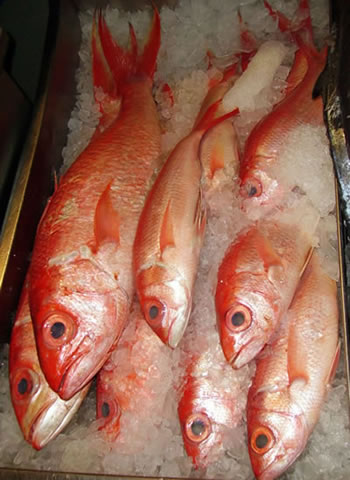

I don't often spend time near the seafood counter at the grocery store, nor do I actively seek out fishmongers on a regular basis. But I can recognize a red snapper, and I was mildly perturbed to see one on display at Wild Edibles Fish Market. I decided to leave one of my Seafood Watch seafood guides with whoever was on duty and send an email to the company when I got home.

Then I looked closer. There was a sign near the snapper with a bright red fish symbol and a description of why red snapper is not a recommended seafood choice. I surveyed the rest of the catch of the day; every fish was marked with a sign, and a not insignificant number carried the red "Avoid" tag. A sign hanging over the counter informed me that Wild Edibles was working with the Blue Ocean Institute to help people decide which seafood to buy.

They even had wallet-sized seafood guides available at the counter.

I was horrified. They were actually selling the fish that their own signs declared threatened or endangered. I asked the woman working the counter, "How can you sell this when you know that it's endangered?" Her response: "Well, we want the customers to decide. If they tell us to stop selling it, we'll stop selling it."

Let's tell them.

Tell them that they ought to know better. Tell them that they do know better. Let them know you don't want to see fish on the menu that, by any account, would be better described as "Endangered Species" than "Catch of the Day". And while you're at it, tell your local fish seller too. Go to your grocery store and see if they're selling red snapper, orange roughy, Chilean seabass, or any other endangered fish. Give them a seafood guide, or two, or ten.

While you're at it, you might want to let the Blue Ocean Institute know what you think of their endorsement, as well. Shame on them for lending their name to an irresponsible fish merchant.

Wednesday, September 17, 2008

Super Supper?

People who know me well are often inclined to ask my opinion about whether something is "good for me." It's an interesting question. I'm not really qualified as a nutrition scientist, food chemist, doctor, or, you know, any other professional food expert. I am a vegetarian, which has made me more aware of what I eat (and more aware about myths concerning protein, for example) but other than that, and being a voracious reader and an enthusiastic Pollangelical, I'm just an ecology graduate student.

But, usually, I have an answer. It's generally along the lines of, "Well, is it a plant? If it's a plant, eat it. If it's not a plant, just eat a little of it." For more information, I turn to the trusty rules of Pollan: does it have more than five ingredients? (Bad.) Are any of them unfamiliar? (More bad.) Are any of them unpronounceable/indistinguishable from the ingredients in your shampoo? (Very bad!)

Now, though, there are new problems. Foods that used to be totally normal foods have become... something else. Do you like sardines, for example? (Many people don't.) What if you couldn't taste them, and they were in your orange juice this morning? Would you like to have some broccoli, kale and beet salad? (Not too appetizing?) That's OK, you can get all your vegetables in a convenient chocolate bar form!

Weird, right? And yet... and yet. Superfood or Monster from the Deep?

So is that chocolate-broccoli-kale-beet bar good for me?

I hope no one asks me, I'm not really sure what to say. I'm pretty sure the answer is, "Well, it's still a chocolate bar!" but what does that even mean any more? What if it supplies all the daily requirements of certain things? I can tell you that eating a square of chocolate will not fill you up, and you'll still want a normal meal. I can tell you that if the rest of your diet is made of burgers and fries, having some antioxidants in your chocolate is probably not going to help you much.

What about having orange juice with sardines in it? Even assuming a negligible flavor difference, shouldn't orange juice have, you know, just one ingredient?

Thoughts from the gallery? I'm moderately sleep-deprived, so let me know if I lost you somewhere along the way.

Monday, September 15, 2008

14 Questions

Have you been wondering where Obama and McCain stand on important science issues? Science Debate 2008 can help. They compiled a list of fourteen general questions about important science issues and put them to each of the candidates.

You can read their full responses here. Too busy to scroll all the way down? (Or is the lack of a Web designer hurting your eyes?) Check out the summary published by the NY Times.

Note: You will not find anything about evolution or the teaching thereof in this article. It just didn't figure into the top 14 questions, I guess. I think that's sort of encouraging, but then again, the people asking the questions are scientists. Would I love to hear John McCain say something dumb about evolution? You betcha, but I don't think it's likely; in the Republican primary debates, there was the following exchange:

MR. VANDEHEI: Senator McCain, this comes from a Politico.com reader and was among the top vote-getters in our early rounds. They want a yes or on. Do you believe in evolution?

SEN. MCCAIN: Yes.

MR. VANDEHEI: I’m curious, is there anybody on the stage that does not agree -- believe in evolution?

(Senator Brownback, Mr. Huckabee, Representative Tancredo raise their hands.)

SEN. MCCAIN: May I -- may I just add to that?

MR. VANDEHEI: Sure.

SEN. MCCAIN: I believe in evolution. But I also believe, when I hike the Grand Canyon and see it at sunset, that the hand of God is there also.

So, there's that. But, I also think McCain is slippery enough to try to get out of that one too, especially with what's-her-name in the game now. Gotta love how he has to qualify his acceptance (we don't like to say belief) of evolution. Also love that they work in some discussion of sustainable seafood! Anyway, now I'm going off on a tangent. Enjoy the articles!

Tuesday, July 1, 2008

Better Know an Arthropod: Bizzaro Lobsters!

Most people are familiar with the lobsters that grace many New England tables this time of year. The American/Atlantic/Maine lobster, Homarus americanus, is a well-known icon of the northeast part of the country and countless J. Crew summer prints.

Therefore, we're not going to discuss them further here today. Perhaps once I read The Secret Life of Lobsters I'll have something interesting to say about them beyond that they're apparently good with drawn butter.

This post is about the bizarro-lobsters of the deep seas. Sharon introduced me to a new one today, so let's view that one first!


The slipper lobster is not a "true lobster" -- it is instead more closely related to some of the other bizarro lobsters, the spiny and furry lobsters. They are achelate, meaning they have no claws. This makes them easy prey for humans, and indeed, if you Google "slipper lobster" you will find their tail meat for sale. (Of course, there is no claw meat to speak of.) Some of them are actually referred to as bugs, which is rather entertaining. No word yet on their position as a sustainable seafood. Not much seems to be known about them, if Wikipedia is at all accurate. Maybe it's better that way.

Next up: spiny lobsters. Popular for eating, also known as "rock lobster", and very colorful. Also, the only arthropod (as far as I know) that was immortalized in song by Fred Schneider (who is also very colorful). Interestingly, spiny lobsters have a unique form of sound production involving rubbing their antennae against a file-like protrusion. I'm not really sure what's going on there, but they're the only ones that do it, so that's neat.

I would tell you something about the furry lobsters, but there doesn't seem to be much to tell. (Except that if you start thinking too hard about the concept of a furry lobster, it can sort of hurt your brain.) Besides, you don't want to hear about true furry lobsters, you want to hear about this:

Kiwa hirsuta

Kiwa hirsuta, also entertainingly known as the yeti lobster, is not a true lobster or in the Achelate group with the other "bizarro" lobsters. Kiwa is in its own brand-new family, Kiwaidae, all by its lonesome. See, this beautiful, samba-dancing lobster, which you might be tempted to call a furry lobster but is not, was only discovered in 2005, chillin' at the bottom of the Pacific ocean. It lives on hydrothermal vents (so, maybe not chillin', per se), is pretty much blind, and may use all those "hairs" to detox after hanging around the vents, which spew mineral toxins.

My favorite part of this lobster is not that it's yellow, not that it's furry, and not that it's a deep-sea critter. (Although I love deep-sea critters, they're so bizarre!) My favorite part is that it was only found three years ago. I spent most of my life on a planet where no humans knew this thing existed! I suppose Kiwa knew it existed, if decapods can have self-awareness. But we did not know. There are still new things out there to find, if we look hard enough! (As I mentioned in my previous post, the world is just awesome.)

So there you have it. OK, true, none of these critters are true lobsters, but they all have lobster in their names and are therefore acceptable for a not-entirely-scientific blog post. (I didn't name the blog "Correctly Taxonomied Creatures," did I?) I hope you enjoyed your bizarro lobsters. Now please pass me some drawn butter, I want to dip my asparagus in it.

Monday, June 9, 2008

Bagels and... what?

Hmm. Zabar's will have their hands full trying to make sardines the new lox. Good luck with that.

Sardines with your bagel?

Despite what seafoodwatch.org might say, salmon is probably best to just keep on your Avoid list. I'm not sure how recently they updated the list, but it probably hasn't been updated since the Pacific fisheries south of Alaska were closed. With prices on Alaskan salmon poised to go through the roof, you might want to find something new to put on your bagel.

Unfortunately, the other classic bagel topper, whitefish, is also a no-go. Atlantic cod, aka whitefish, is a big red Avoid on that list. But if you're a fan of herring in cream sauce, you're doing A-OK, since herring (aka sardines or kippers) are considered a Best Choice.

Of course, the other option is to not put any fish on your bagel at all. I like mine toasted with a little butter, tomatoes, and a slice or two of manchego. Simple, delicious, and definitely dolphin-safe!

Friday, May 30, 2008

Guano

There was about a week there with no posts; sorry about that. I was busy, and there was Memorial Day weekend, and it took a few days to get myself back together.

This article, in two short pages, manage to cram in a lot of interesting information about colonialism, the pre-petroleum world, sustainable fishing, sea bird conservation, organic farming, and other topics.

Peru Guards its Guano as Demand Soars Again.

Guano is bird droppings; colonial birds such as the cormorants and boobies mentioned in this article produce a lot of it every year. Before humans figured out a way to make synthetic fertilizer (leading to corn that is grown with petroleum, which doesn't really help us when you make it into ethanol), guano was the richest soil amendment you could buy.

What I'm not too clear on is why seabird guano is so particularly sought after. We have millions of captive chickens, turkeys and ducks; can't we use some of their droppings in a similar way? If anyone has a good explanation about this (is it something about the level of fish in the diet?) I would love to hear it.

Anyway, it's an interesting article. It gives a little more insight into just how this massive food chain we've created works. Fish that would go to seabirds are instead going to chickens (which don't normally eat fish); declining seabird numbers means less guano for organic farmers to use on vegetables. The price of petroleum goes up to the point that "conventional" petroleum-based farming is too expensive, so farmers of all stripes are looking for alternative fertilizers.

Thursday, May 1, 2008

Food, Food, Food

Food is so hot. Food is one of the reasons I started a blog. Yet I haven't been posting nearly enough about it!

There have been two articles in the NY Times worth checking out recently. One is part of a series called "The Food Chain" which is in the business section about the global food crisis and various other food issues. The articles is "Shortages Threaten Farmers' Key Tool: Fertilizer." The long and the short of it, again, is that we should stop eating meat. Really.

The other article actually says that we should eat more meat, assuming that meat is from a heritage breed or other endangered, culturally significant food source: "An Unlikely Way to Save a Species: Serve it For Dinner". For the most part, I agree with the perspective of this article; too many heritage breeds and heirloom varieties are being lost to the uniformity of global food production.

However, I have to take issue with a few of the species they list in the infographic as food supplies worth conserving, including leatherback sea turtles, wild bison and Snake River chinook salmon. They do mention this to a degree in the article, with regards to the flying squirrel (yep, squirrel is on there too), but I just feel like they don't talk enough about the species on here that we need to do a lot more for than just eating them; that, in fact, we might do better for by not eating them at all. I think putting the species on this list at all, although they may be culturally significant, is not going to do them any favors. This is especially true for the poor over-harvested salmon; hopefully no one will look at this article and say, "Well, we're harvesting a heritage food, we'd better keep eating them to conserve them!" Maybe I'm underestimating people, but... I don't know. It's a little disconcerting. Definitely interesting in regards to the fainting goats and the Makah ozette potato, though!

If someone figures out a cure for chestnut blight based on wanting to eat them, that might be wonderful. Seeing a chestnut stump with sad little sprouts is a tragedy.

PS: I have never been to a clambake.

Wednesday, April 30, 2008

Shark Ballet

Continuing a week of "I'm too busy to post about stuff myself, so here are some interesting animals to look at instead."...

Just when you thought it was safe to go back in the water around South Africa...

Great White Sharks -- Planet Earth

There are many, many documentaries on sharks. Discovery has a whole week of them, for cryin' out loud. People love the bloody, violent footage of sharks mangling their prey, attacking cages, and generally being eating machines.

But -- this one is a real standout among all the millions of hours of shark footage out there. The high-speed camera allows the producers to slow down the action so we can see a 20 foot great white fully out of the water, gracefully suspended in the air. It's haunting, and beautiful. Instead of showing the blood and gore that we typically associate with feeding sharks, we see the power, the elegance, and the sheer strength behind the teeth.

Damien Hurst wishes he could make it look so good.
Interestingly, recent studies have suggested that great whites are actually somewhat social creatures that have developed ranking hierarchies, communication via body language, and other traits that we typically think of as "advanced." Natural History did a cover story on it a little while back, and it's a great read -- plus, more fantastic photos of sharks leaping out of the water! Some of the behaviors they describe may sound familiar; you've probably seen bison or other large mammals perform very similar ones, and for similar reasons. There's a lot more going on in the deep sea than we thought!

Oh, and they're curious, have distinct personalities, and don't appear to care for the taste of human. So if they come up and nibble on you, it's only because they're not sure what you are. Reassuring, no?

Wednesday, April 16, 2008

Avast!

OK, let's get something straight here. I am fond of 18th century-style pirating. Not 21st century style pirating.

Jack does not approve of whaling, unless whales are full of rum!

BUT! I am incredibly excited about eco-pirates, or "pirates of compassion" as they style themselves.

Green Pirates Claim Victory

It's really sad that countries I otherwise have no real problems with (Canada, Japan) insist on maintaining these out-of-date marine mammal hunts. Whaling is so nineteenth century! But it seems like the pirates did a fantastic job; the Japanese whaling ships were only able to take about half the number of whales they had set out to brutally slaughter, and none of those were fin or humpback whales. It's still a few hundred whales too many for my tastes, but still -- a good thing for cetacean-kind!

Jumping for joy!

Victory via coconut cream. That has got to be the best pirate I've ever seen!

Wednesday, April 2, 2008

Chatham cod

Before I launch into this post, I just want to clarify: I do not eat bacon (or any other meat for that matter), and I do not want a gas-guzzling atrocity like a stretch Hummer as my wedding transportation. Check the date stamp, people. NEVER trust anything I tell you on April 1.

Today being April 2, however, feel free to believe away.

I don't know why the Times hasn't just combined the Dining & Wine section with the Science section. It seems like every week there are new articles about food and ecology, which, of course, are basically the same thing. (You said so yourselves, in my poll last week.) Last time it was salmon trouble. This week, it's cod and herring.

This is a cod. They don't start out as fish sticks.

Not a lot of new things to tell you about here. Same old story: we caught too many fish, the stock plummeted, we stopped catching them, they're doing better but still not great, and part of the problem is that we forgot to take into account that no species of fish exists in a vacuum. We (humans) are particularly fond of fish that eat other fish, so when the numbers of the prey fish drop, so do the ones we like to eat. Yay ecology.

Friday, March 28, 2008

S.O.S.

Save Our Seals!

It's late March, which means it's time for a different kind of madness...

Canada's seals are once again in danger of being brutally clubbed to death
.

Yesterday I said I was in favor of some hunting of deer in NJ. Things that I am decidedly not in favor of include brutal, medieval hunting techniques; killing baby animals just a few weeks old; and skinning animals while they're still alive -- all to benefit the fur industry. Seal hunting is a far cry from the forest management/subsistence hunting of white-tailed deer.

So if you think this:
is cuter than this:then YOU have a responsibility to spread the word about this shameful hunt. If you eat fish, boycott Canadian seafood. (More information on the other end of the links about how, where, and why.) Tell everyone you know about seal hunting. This slaughter serves no purpose beyond indulging the "fashionable" elite in their desire for sealskin clothing. Haven't we moved beyond that? Blood on the ice will never be fashionable.

Please note: They're really not kidding about the graphic images in the video. May cause the following: tears, revulsion, anger, compassion, dismay, renewed desire to bring about change, loss of appetite for Canadian seafood.

Wednesday, March 26, 2008

More salmon news

Apparently, southern hemisphere salmon aren't doing any better than northern. This time, though, it's farmed salmon in Chile that are poorly. Of course, farmed salmon in general isn't sustainable... they're carnivores, and it takes four to six pounds of other fish to raise a pound of salmon. Where does that fish come from? I don't really know. But it's coming from somewhere in the deep blue sea, and the seas are becoming more and more empty. Plus, farmed salmon in areas where salmon normally live can intermingle with wild populations, spreading both diseases and genetic material and contaminating the wild fish. When it comes to salmon, wild caught is still the best. Oh, and did I mention that these (in the article) are Atlantic Salmon? That are being farmed in Chile? Where they don't belong in the first place? And that some of them are escaping and eating the native sea life? Yeah. Bad situation all around.

By the way, the article specifically mentions Costco and Safeway as retailers that sell Chilean salmon. Don't buy it, and let them know why!

Monday, March 24, 2008

Passover is a month away...


... but I had to post these incredibly/disturbingly cute (?!?) gefilte fish anyway.

I don't even eat them, but that's just so adorable. How springy! (Much like a piece of gefilte fish.)

Tuesday, March 18, 2008

Chinook Salmon

I recently read No Way Home, a book about migration as an endangered phenomenon. I was partially reading it to get ideas about how my thesis (on dragonfly migration) plays into the larger concepts of conservation and ecology and partially reading it because it's the sort of book I would read on my own anyway. Dragonflies are only part of the story; a large part of the book talks about salmon migration and what we humans have done to interfere with it. (A lot, in case you didn't know.)

Anyway, here's a little more information about it: Chinook Salmon Vanish Without a Trace.

So... definitely a good idea to start double-checking where your salmon comes from for the next few years. Stocks are low in many areas. Here is the Monterey Bay Aquarium page on salmon. Their guide to sustainable seafood is one of the best resources for fish lovers who don't want the oceans to be empty, although this page doesn't seem to reflect this latest update on Pacific salmon.