Tuesday, January 13, 2009

DIY Dairy II: The Curdling

A while back, I talked about my interest in making my own yogurt.

Tonight, I'm going to try a new experiment: I'm going to make my own cheese.

As before, you may have your doubts, reminding me that caves are often an integral part of the cheese industry and that I live in an apartment (and not a very cave-like one, at that).

But Mr. Bittman says it can be done at home, and quite easily. And, I have an important ingredient: motivation. When I lived in Manhattan, I had the world's best sheep milk ricotta available whenever I wanted it from the Fairway cheese counter. I remember the first time I tried it; I had asked the cheesemonger on duty where I might find the ricotta, and he said to me, "Well, that Polly-O stuff and all the others are around that corner, but... try this." He produced a spoonful of the creamiest, lightest, most delicious ricotta I had ever tasted. (They kept it behind the cheese counter, available only by request.) I made a fine baked pasta that night, and every bite was a song of praise to the sheep that had produced the milk. That ricotta tasted of excellent milk, open green pastures and fresh air. Polly-O and all the others, after that, only tasted like processed, fake food.

Sadly, I do not currently have a source for this miraculous ricotta. When the farmer's market season fires up again I will be able to get some, but I have a tomato-blue cheese tart planned for Thursday and I need some good ricotta today.

Which is why I am going to make my own cheese.

The basic principle of cheese-making is this: if you start with milk and add something that acidifies it, the proteins will stick together in clumps (curds) and separate from the liquid (whey). Strain the whey from the curds, press them together, add salt and other flavors. Age as you see fit. A simple process in principle, but with lots of room for improvisation.

When you acidify the milk with an acid, you get something like feta or cottage cheese. However, most cheeses are made at least in part with the help of our friends, the bacteria. Bacteria break down the sugar in milk (lactose) and turn it into organic acid (lactic acid). This acid then causes the reaction I described above. You already know this if you have encountered milk that is very far beyond its expiration date; it smells sour and gets a bit clumpy at the bottom.

The recipe Mr. Bittman gives calls for buttermilk, which is made by innoculating milk with a bacterial culture, similar to a very thin yogurt. (Historically, buttermilk is what remained after skimming the milk to make butter, but that is rarely available in your average supermarket today.) The milk is simmered for a few minutes, the buttermilk is added all at once, and, with a little luck, everything will curdle nicely. The whole mixture is put through a cheesecloth, salted, and drained.

I will let you know how it goes tonight in my laboratory kitchen. I'm using cow milk, since sheep milk is not available at Stop n Shop. In the meantime, check out the Wikipedia page on cheese. Interesting things to know:
  • The history of cheese predates recorded history.
  • Acid-set cheeses (as opposed to rennet-set) will not melt; they have a different kind of protein matrix holding them together and only get firmer as they cook. (Paneer is a good example.)
  • The US is the world's biggest producer of cheese, but France is the biggest exporter. But the true title of cheese-eating champions goes to Greece, which eats more cheese per capita than any other country. (However, three quarters of it is feta cheese.) France is a close second.
There are a lot of things I didn't talk about here that relate to cheese making, including rennet and fungus. While I would like to discuss them in the future, I won't be using either in my cheese-making attempts tonight, so I will have to leave them for another time.

PS: A little late, but... Happy New Year!

Wednesday, December 24, 2008

Small and Blue and Beautiful

Yesterday I blogged about something very small.

Today I'd like to call your attention to some articles that talk about something very big.


Forty years ago today, astronauts took this historic photo, "Earthrise". I didn't remember that until reading the editorials in the Times, of course, since I wasn't around yet. Some say that this image helped jump-start the environmental movement.

Anyway, the articles from today and from 1968 are worth checking out. Here is today's editorial reflecting on 1968 and now; this op-ed piece observes that while *we* may be fragile, life on earth has endured worse than humans and survived. From the first editorial, click on the "Related Articles" links to download some of the original articles from 1968, which are not available as web pages. This photograph is also so famous that it has its own Wikipedia page.

From the 1968 editorial:
To see the earth as it truly is, small and blue and beautiful in that eternal silence where it floats, is to see ourselves as riders on the earth together, brothers on that bright loveliness in the eternal cold — brothers who know now they are truly brothers.
Lovely.

PS: For more on "Earthrise" and a short video clip from the Apollo 8 mission, visit this Dot Earth post from today.

Tuesday, December 23, 2008

The 40 Million Year Old Virgins

Imagine, on this cold near-solstice day, that in the spring you go out to a nearby pond and collect a sample of water. You bring it home, put a drop on a microscope slide, and take a look at the pond's microcosm. Zooming around your sample are a wide variety of "wee beasties" -- you might see a blobby amoeba, a diflagellate like Chlamydomonas, and many other single-cell organisms.

Then a large, mostly transparent creature comes into focus. It doesn't look like all the others. It's far more complex, like a mechanical sea creature in miniature. Something like this:


Beautiful, isn't it?

This is a rotifer, a tiny aquatic animal in the phylum Rotifera. It may be small, but it is bilaterally symmetric and has a distinct head. It pulls in food particles with the wheel-like structure (hence "rotifer" or "wheel-bearer") around its mouth.

The rotifer pictured above is, however, special for another reason. This is a bdelloid rotifer (the b is silent). You are looking at a species that has not mated in at least 40 million years.

All bdelloid rotifers are female, and they reproduce by parthenogenesis. (Olivia Judson talks about them at length in her excellent book, Dr. Tatiana's Sex Advice to All Creation, and wrote a column about them in June.) This is highly unusual, since it is generally thought that gene exchange is an important mechanism for evolution. Yet with no sexual reproduction, how could the bdelloids have speciated so intensely (there are estimated to be 350 species) and persisted for so long?

Researchers at Harvard and Woods Hole may have the answer. In a paper published in Nature in May, geneticists found that when they analyzed rotifer DNA, they found genes known to occur in plants, fungi, and bacteria. This evidence suggests that rotifers have been engaging in horizontal gene transfer (HGT).

HGT is a well-known phenomenon, but it was primarily known from single-celled organisms. For example, many bacteria are known to incorporate novel genes from other members of the population, or even from other species. When you only have one cell, it's not too hard to get a novel gene into that cell. Most animals, which are by definition multicellular, can't do this; most of us pass our genes to our offspring via specialized reproductive cells, which are typically hidden away inside gonads. Unless novel genes make it to the sex cells and can therefore be passed on to the next generation, HGT has not taken place. (Passing genes to your offspring is vertical inheritance.)

Bdelloids, however, appear to be capable of massive horizontal gene transfer. Gladyshev et al. point out that this is not a case of rotifers simply retaining genes that are common to all life; that case is both extremely unlikely and not supported by the data. Instead, they suggest,

It may be that HGT is facilitated by membrane disruption and DNA fragmentation and repair associated with the repeated desiccation and recovery experienced in typical bdelloid habitats, allowing DNA in ingested or other environmental material to enter bdelloid genomes.

With their proclivity for moist habitats, bdelloids also run the risk of dessication. They are able to withstand repeated dessication; in fact, it might be necessary for the continued success of the entire class, since this appears to be the mechanism by which they gain new genetic material. The authors conclude,

Although the adaptive importance of such massive HGT remains to be elucidated, it is evident that such events have frequently occurred in the genomes of bdelloid rotifers, probably mediated by their unusual lifestyle.


So, in conclusion, bdelloids have done away with sex as we know it, but periodically get turned into rotifer jerky, incorporate new genes while their cells are cracked open, and when reconstituted and repaired produce more copies of themselves, thus passing new genes to the next generation.

Lots of questions remain; for example, what are rotifers doing with all these new genes? (One example is a bacterial gene for cell walls; no one knows how an animal might make use of a cell wall.) I will keep you posted on all rotifer-related news updates. Stay tuned!

References
Gladyshev, E. et al. "Massive Horizontal Gene Transfer in Bdelloid Rotifers." Science 30 May 2008: Vol. 320. no. 5880, pp. 1210 - 1213

Judson, O. "The Weird Sisters" The New York Times, June 3, 2008.

Monday, December 15, 2008

Plants Fighting Back

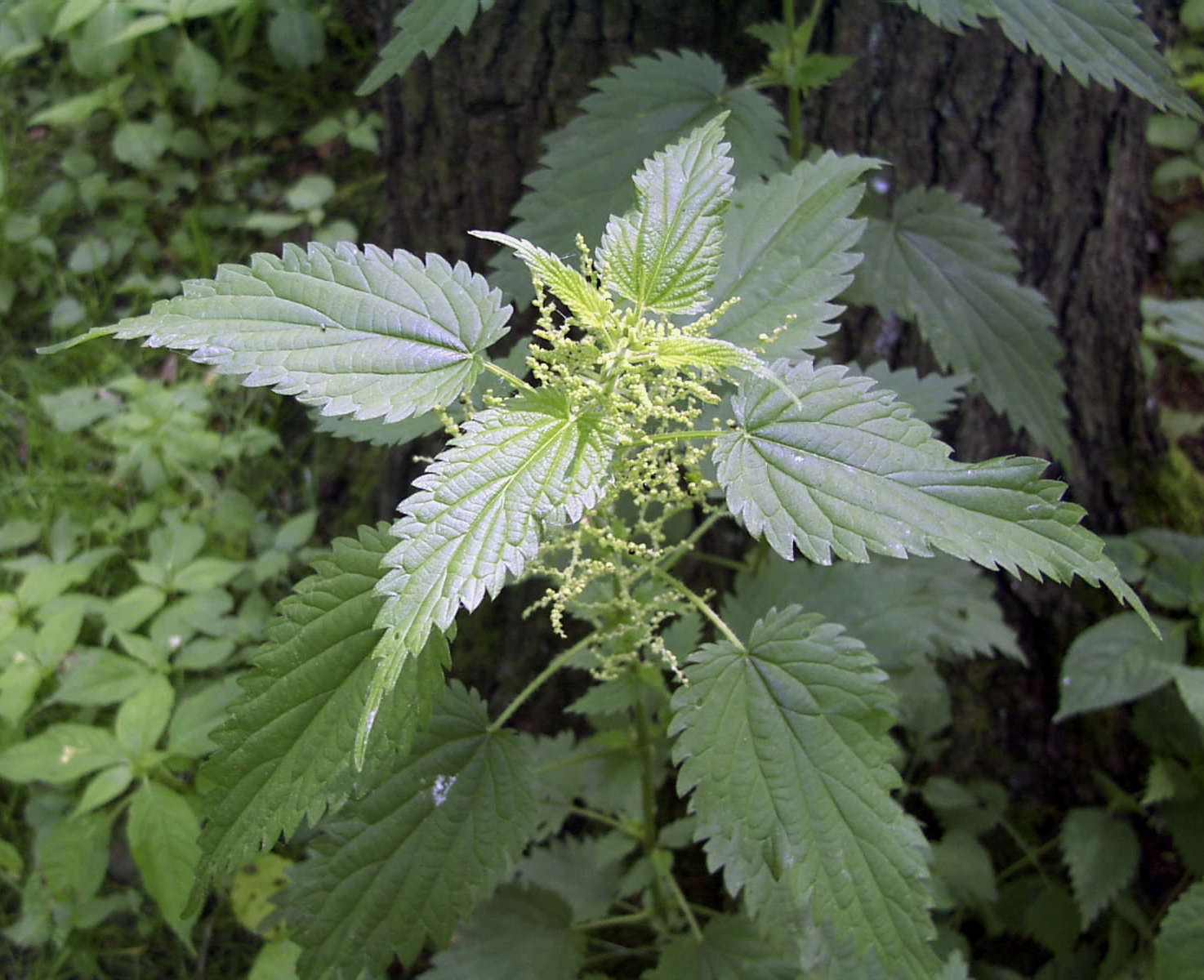
On Tuesday I reached into the container of cilantro from the grocery store and quickly pulled my hand back in surprise. Something had hurt me! But what?

My thoughts went to some alarming places. Bits of metal? Shards of glass? I felt like I had been pricked by something sharp, but there were no marks on my fingertips. No blood was drawn.

I dumped all of the cilantro into a colander and moved it around with a fork. There in the middle was the culprit. Initially its camouflage had concealed it from sight, but on closer inspection it stood out from its surroundings.


Clearly, those are not cilantro leaves. Any guesses?

It turned out my instinct was correct, because the first page I pulled up on Wikipedia was stinging nettle, where I saw the above picture. The plant mixed with my cilantro was the spitting image.

What makes a stinging nettle sting? The sting is caused by a combination of chemicals, not just by the hairs alone which, although sharp, are tiny. Tiny and hollow, and filled with a combination of chemicals that give a noticeable irritation: acetylcholine, serotonin, and perhaps most importantly, histamine and possibly formic acid. Yikes.

Surprisingly, nettles are easily tamed, and can be made into tea or even eaten when young ( and cooked). They're also good for your hair, feature prominently in hippie-dippie shampoos, and are mixed into cattle feed to give the bovines shiny coats. My nettle, however, was transferred by fork to the trash bin, as I was in no mood to attempt to tame it. (And my hair is already quite shiny, thank you.) I do admire it for fighting back, though. As a vegetarian, I'm not really used to food that puts up much of a struggle, so this was an interesting interaction between me and a plant.

But I think I'll stick with cilantro just the same.

Thursday, December 4, 2008

Wild Edibles Seafood Market, or, What Not to Buy

Over the long weekend, I visited Grand Central Station to check out the holiday marketplace. While we were there, our group also visited the food markets . I love the temple of dairy that is Murray's Cheeses, and Penzey's Spices is always a treat.

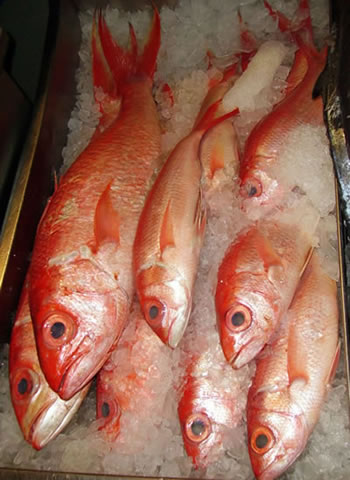
And then I was face to face with a red snapper.


I don't often spend time near the seafood counter at the grocery store, nor do I actively seek out fishmongers on a regular basis. But I can recognize a red snapper, and I was mildly perturbed to see one on display at Wild Edibles Fish Market. I decided to leave one of my Seafood Watch seafood guides with whoever was on duty and send an email to the company when I got home.

Then I looked closer. There was a sign near the snapper with a bright red fish symbol and a description of why red snapper is not a recommended seafood choice. I surveyed the rest of the catch of the day; every fish was marked with a sign, and a not insignificant number carried the red "Avoid" tag. A sign hanging over the counter informed me that Wild Edibles was working with the Blue Ocean Institute to help people decide which seafood to buy.

They even had wallet-sized seafood guides available at the counter.

I was horrified. They were actually selling the fish that their own signs declared threatened or endangered. I asked the woman working the counter, "How can you sell this when you know that it's endangered?" Her response: "Well, we want the customers to decide. If they tell us to stop selling it, we'll stop selling it."

Let's tell them.

Tell them that they ought to know better. Tell them that they do know better. Let them know you don't want to see fish on the menu that, by any account, would be better described as "Endangered Species" than "Catch of the Day". And while you're at it, tell your local fish seller too. Go to your grocery store and see if they're selling red snapper, orange roughy, Chilean seabass, or any other endangered fish. Give them a seafood guide, or two, or ten.

While you're at it, you might want to let the Blue Ocean Institute know what you think of their endorsement, as well. Shame on them for lending their name to an irresponsible fish merchant.

Wednesday, November 26, 2008

Better Know an Insect: Fungus Farmers

Happy Thanksgiving!

A few weeks ago, I read some interesting papers about mutualisms in ecological networks.

Here is a thought-provoking opening sentence from one of them:
About 40 – 60 million years before the advent of human agriculture, three insect lineages, termites, ants, and beetles, independently evolved the ability to grow fungi for food (Mueller & Gerardo, 2002).

As you digest your delicious Thanksgiving meal, think of all the things we farm, and the complex relationship we have with agriculture, with farmers, and with the organisms we farm. Then contemplate that insects did it all way before us with their tiny little nervous systems.

Leafcutter ants are one of the lineages that have developed the ability to farm. You might have seen leafcutters in a museum -- they're popular exhibits because they will build their entire colonies readily inside an enclosure and only require a steady supply of leaves. They are the champion farmers of the insects; in some areas, they are considered major agricultural pests because they will strip all vegetation near their colonies to feed their fungus colonies.

The life cycle of leafcutter ants is something like this: when a new queen hatches, she takes a small amount of her home colony fungus along with her on a specialized structure on her thorax when she makes her nuptial flight. After mating, she founds a new colony with the fungus she carried with her. The fungus grows on decomposing vegetation -- leaves -- which the queen initially supplies. After her first offspring have developed, they take over the role of leaf-gathering so that the queen can focus entirely on laying eggs.

Humans go to great lengths to maintain their crops. We spray insecticides, fungicides, and other chemicals to keep our crops disease-free. Ants have developed a system to do this as well -- on each worker is a small patch containing beneficial bacterial colonies. These bacteria secrete antibiotics that help protect the fungal crop from disease. The ants can also adjust the kind of vegetation brought into the colony, and will not bring leaves that have previously been rejected by or toxic to the fungal crop.

Two amazing, related facts about leafcutter ants: 1) they are native to the Americas (especially Central and South America) and are not found on other continents; therefore, when you see a line of leafcutter ants in The Lion King (sorry, I'm having a hard time finding a screenshot) that is an error.

2) While most leafcutters make their homes in the tropics, one species actually lives as far north as southern New Jersey.

There's loads more to say about leafcutter ants, but I mainly wanted to talk about farming in this post, since it sort of relates to Thanksgiving. Perhaps I'll write about them again soon. Eusocial insects are my favorite insects to talk about since they do so many amazing things. Look for more on ants in the future!

Sources:
Mueller, Ulrich G. and Nicole Gerardo. Proc Natl Acad Sci U S A. 2002 November 26; 99(24): 15247–15249.

Tuesday, November 4, 2008

Vote.

Get out and vote! Go on! Go vote!

Vote because, if you're a woman, your right to vote is less than 100 years old. Honor the women who struggled to get you that right!

Vote because you don't get to complain if you don't vote.

Vote because you can get a free cup of coffee at Starbucks and a free cone at Ben & Jerry's if you tell them that you voted.

Vote because all your friends on Facebook are voting. (All the cool kids are doing it!)

Whatever your reason, whatever your voting preference, go do it!

Friday, October 31, 2008

Barack O'Lanterns

Just a little something fun for Halloween...


The image is watermarked, but here's a link: YesWeCarve.com. They even have stencils for you to make your own Barack O'Lantern. (Jack O'bama? No, definitely Barack O'Lantern.) Gotta love the flexibility of that sunrise/O logo. It's a sun! It's a notebook! It's a pumpkin!

Thursday, October 30, 2008

Sarah Palin Loses the Geneticist Vote

This is already burning up in the science-oriented part of the blogosphere, but I want to mention it here too.

I've talked before about how Sarah Palin is a heartless lawbreaker who would love to shoot every wolf in Alaska. But did you know she's also opposed to basic scientific research?

Well, more specifically, she doesn't know what she's talking about when it comes to research. Otherwise, why would she highlight spending on fruit fly research in Paris as a "pet project earmark"? Did no one in the McCain campaign bother to find out what kind of research they were doing? I hate to tell you this, Ms. Palin... but fruit flies are the favored lab animal for genetics research around the world, both in Paris and here in the good ol' USA. (Except for New Jersey, which is not part of the "real" America.)

I think PZ Meyers, who writes the excellent blog Pharyngula, said it best:

Yes, scientists work on fruit flies. Some of the most powerful tools in genetics and molecular biology are available in fruit flies, and these are animals that are particularly amenable to experimentation. Molecular genetics has revealed that humans share key molecules, the basic developmental toolkit, with all other animals, thanks to our shared evolutionary heritage (something else the wackaloon from Wasilla denies), and that we can use these other organisms to probe the fundamental mechanisms that underlie core processes in the formation of the nervous system — precisely the phenomena Palin claims are so important
.

Oh, and he also threw in this disturbing but excellent point:

You damn well better believe that there is research going on in animal models — what does she expect, that scientists should mutagenize human mothers and chop up baby brains for this work?


If you're interested in watching, Think Progress has a video clip of Palin delivering the remarks. You can read the original prepared text at the McCain campaign page, but they differ somewhat from what she actually said. (For example, sarcasm is not noted anywhere in the prepared text.)

With the election so near (I've been unable to think of anything else lately), I think it's important to recognize what a McCain victory would do to the scientific community. Government funding for basic research is non-negotiable.

Tuesday, October 14, 2008

Dinosaur Documentary Drinking Game

Last night, D. and I watched a Nova episode about Arctic dinosaurs. (You can view the whole episode online!)

D. is a remarkable and patient man, for I know few people other than him who could tolerate watching a TV show about dinosaurs with me. I am incredibly annoying. I have a tendency to argue with the television, pause the show to make a comment about what I feel is wrong with the most recent shot, and so on. I do this a lot with science shows in general, but dinosaur shows for whatever reason have a greater likelihood of skewing towards hyperbole. (That, and I don't know enough about astrophysics or material science to keep up my end of the argument.)

I guess I must have paused the action one too many times (is three times in the first ten minutes a lot?), because D. turned to me and said, "You know, we should create a dinosaur show drinking game."

Voilá. We took notes during the show and added a few other things based on previous things we've watched. (Walking with Dinosaurs, etc.)
  • Drink for tired clichés -- "gentle giant", "vicious carnivore" etc. -- that make assertions about an animal's temperament based solely on what it eats. (Cape buffalo and hippos are herbivores, but no one would call them gentle!)
  • Drink for scientific inaccuracy, like showing T. rex urinating on its territory. (Feel free to call me if you aren't sure. Here are a few to start you off.)
  • Drink for Jack Horner. (Jack Horner is awesome!)
  • Drink every time they show a digital animation of an asteroid hitting the earth at the end of the Cretaceous. Drink twice if the ensuing explosion is reflected in the eye of a dinosaur.
  • Drink for Montana.
  • If anyone says "Brontosaurus," (including the narrator!) finish your drink.
  • Drink each time a prehistoric critter breaks the fourth wall (bumps the camera, etc.) -- prevalent in the "Walking with..." series.
  • Drink for paleontologists in cowboy hats. (One drink per hat.)
  • Drink for dinosaur-on-dinosaur violence or dinosaur mating.
  • When a female paleontologist or other scientist appears, finish your drink. (Don't worry, guaranteed not to happen more than once per show. The Wikipedia page for Sue is longer than the page for the woman who discovered her. These are very male-dominated shows.)
Grab a couple of beers and your TV Guide -- there's always something about dinosaurs to watch, whether on Discovery Channel, PBS, National Geographic or Animal Planet.

In the end, though, as critical as I am of these shows, I have a deep affection for them. Perhaps its the part of me that hasn't stopped hoping to see a real, living dinosaur someday, or maybe I'm just a nature nerd. I couldn't tell you which. But check out the Arctic dinosaur show, it was actually quite interesting. Bring a beer over to your computer while you're at it. Keep an eye out for cowboy hats.

PS: Forgot to mention -- if you have anything to add to this list, please leave a comment!